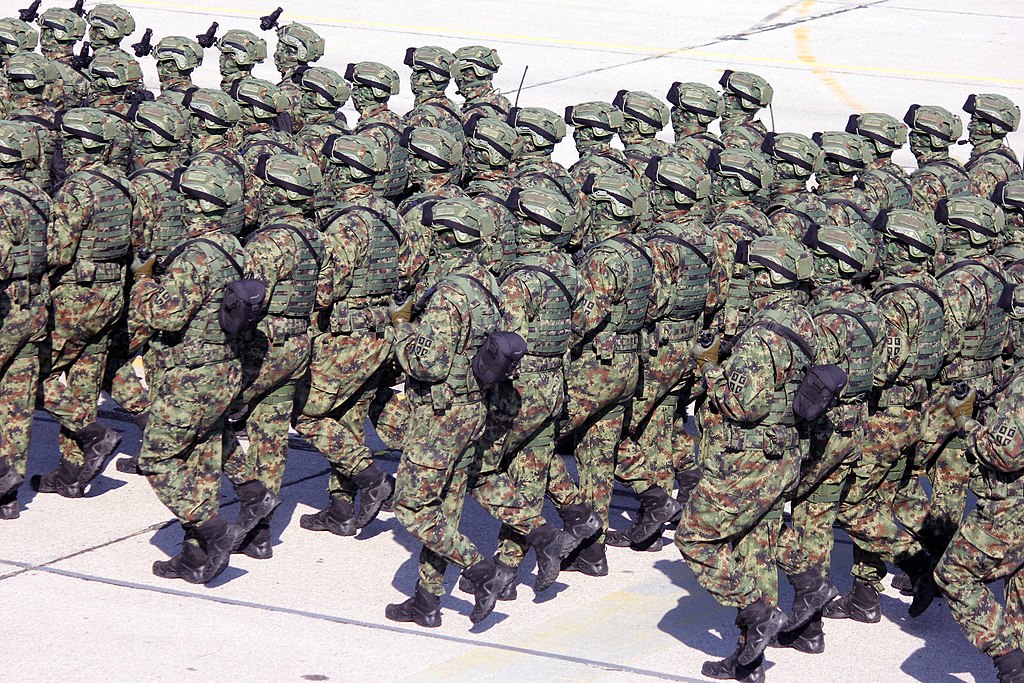
By Marko Mocevic | Rising Expert for Eastern Europe | July 20, 2023 | Photo Credit: Wikimedia Commons
Tensions between Serbia and Kosovo recently escalated, undermining renewed efforts to normalize relations envisaged by the latest agreement between the two nations. While a restart to the European Union (EU) mediated dialogue is warranted, a series of developments following the deal suggest that this agreement, like previous ones, may fail to resolve the entrenched dispute.
The “Agreement on the path to normalization between Kosovo and Serbia,” previously known as the French-German proposal, is the EU’s revamped attempt at mediating the long-standing impasse. Both Serbian and Kosovar leaders agreed in principle to the plan in February 2023. A month later, they reached a tentative agreement on a 12-point implementation annex at a EU facilitated meeting in Lake Ohrid, North Macedonia.
But only months after a tweet from the EU’s foreign policy chief in Ohrid suggested enthusiasm for the restart of talks, relations between Serbia and Kosovo have deteriorated to a dangerous level, raising doubts about the agreement’s potential to solve the morass while demonstrating the intricacy and ambiguity underpinning the Belgrade-Pristina dialogue.
For some context, on May 26, members of the Serbian minority in Northern Kosovo staged protests blocking newly elected mayors from assuming their positions. Kosovo police responded to protesters with force, resulting in dozens of injuries and Western backlash. Serbia reacted to the violence by placing its military on full combat alert. The uptick in violence follows bickering and contradictory statements that beleaguered the new agreement from the start, hampering renewed efforts to normalize relations.
After both leaders accepted the agreement and the implementation annex verbally, diverging opinions quickly surfaced and the topic of the Association of Serb Municipalities (ASM) was glossed over. In April, a meeting in Brussels failed to produce a mutual understanding on the ASM with both sides interpreting the “nature of the association” differently. After protests in late May, the situation in Kosovo remains tense as Kurti refuses to accept Western recommendations to deescalate.
These instances are a reality check on this agreement’s ability to achieve a substantive and enduring normalization of relations. Bickering, incompatible interpretations of the deal, and violence have done little to foster confidence in the agreement. They are also highly reminiscent of previous attempts to solve the dispute.
All the way back in 2013, Serbian and Kosovar politicians committed to finding a solution with the Brussels Agreement, which instructed both sides to implement a 15-point-plan aimed at normalizing relations. Negotiations following its signature saw relative progress but ultimately lacked full implementation in key areas. Of note, Kosovo failed to establish the ASM as outlined by the agreement’s first six points. Frustrated by Pristina’s reluctance to establish the ASM, Serbia instituted a diplomatic policy urging UN member states to derecognize Kosovo in 2017. Subsequent tit-for-tat responses by both sides drove a greater wedge in the dialogue.
With talks stalled and tensions escalating, U.S. officials tried to revive the dialogue with the Washington Agreement in 2020. The deal was a practical and well-intentioned attempt at reenergizing talks by emphasizing economic cooperation. U.S. officials visited both Serbia and Kosovo to show their support, but the initial enthusiasm quickly dissipated. A political change in Pristina, coupled with a lack of domestic will to implement the deal meant little progress. Ultimately, a gap between aim and implementation hampered realization of both deals.
A Way Forward
In light of recent events, Western officials must work diligently to orient both sides towards constructive dialogue. Otherwise, the new agreement is at risk of unraveling. There is also an impetus on leaders in Belgrade and Pristina to limit escalatory rhetoric and actions that undermine the agreement.
After the violence subdues, officials should address the lack of credible representation in Serb-majority municipalities, which resulted from election boycotts. Moreover, fears of violence against Serbs in Kosovo – perceived to be exaggerated by some – are a real concern for those in Belgrade and Northern Kosovo. Initial police reactions to protests, coupled with instances of targeted violence against Serbs on Orthodox Christmas Eve in 2023, do little to assuage Serbian minority’s fears. These examples only create more resentment and distrust, demonstrating Pristina’s inability to integrate and protect the Serbian minority while begetting more violence.
Finally, Kosovo must follow through on its obligations to implement the ASM as underscored in the new agreement and past deals. Given Kosovo’s history as an autonomous province within Yugoslavia, Pristina should understand the value of a minority’s desire for greater self-governance. Acquiescing to calls and obligations for limited autonomy will foster stability and ensure the agreement’s success. Western diplomats have urged Pristina to establish an association, underlining its significance in talks. Kurti – unlike his predecessors – should enable a structure of self-governing Serb municipalities, while Serbia should stop blocking Kosovo’s membership in international organizations.
The U.S. and EU can use carrots and sticks as leverage if either party violates points of the agreement. Recent sanctions placed on Kosovo are a good example how the West can apply pressure to ensure each side continues negotiations.
Initially viewed as a breakthrough to the protracted dialogue, the Ohrid deal shows that past performance is often a guarantee of future results in the Balkans. The new agreement has the potential to normalize relations if the promises made at Ohrid are not belied by actions and rhetoric that incite violence rather than instill compromise.
Marko Mocevic is YPFP’s 2023 Rising Expert for Eastern Europe. He is a Program Analyst for Headquarters, Department of the Army. Marko is also a 2018 Boren Fellow, part of the inaugural cohort of the DoD John S. McCain Strategic Defense Fellows Program, and a former Army Emerging Leader Fellow.

 Charged Affairs
