By Anjali Bhatt | Rising Expert for Economics | September 6, 2023 | Photo Credit: imgur
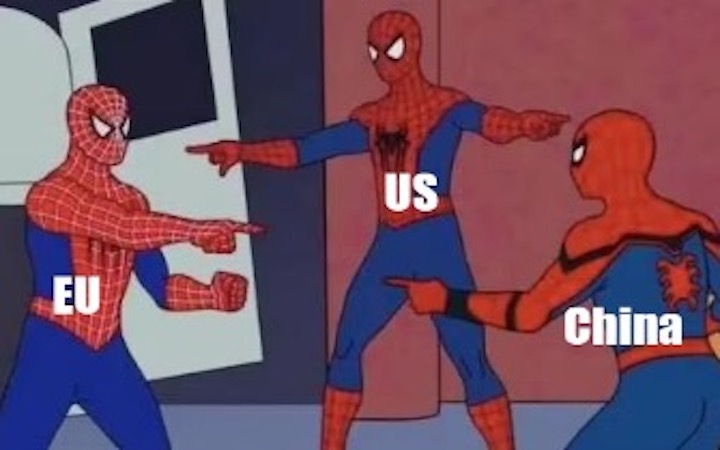
If you’ve spent any time on the Internet, you’ve probably seen this famous meme (above).
The “Spider-Man pointing” meme is often used to illustrate when numerous actors are in direct tension with one another, each positing they are The Original. It’s been applied in many different contexts and can now explain how the world’s three largest economic powers – the United States, European Union (EU) and China – have been behaving recently. Each accuses the others of engaging in harmful economic activities while themselves carrying out similar activities, insisting their policies are acceptable and necessary.
Perhaps the most conspicuous example is how each talk about economic coercion. While there is no one definition of economic coercion, it can be boiled down to: actions or threats by a state (or bloc) to impose economic costs through means like trade, investment, and commerce on a foreign actor to extract policy concessions or punish undesirable behavior with intent to change it.
A Group of 7 statement in May 2023 established a “Coordination Platform on Economic Coercion,” though is light on specifics. It has buzzwords like concern about undermining “trust in the multilateral trading system,” and consequences for “weaponiz[ing] economic dependencies,” which are thinly veiled references to China’s coercive economic practices. China deploys these practices as retaliation against what it sees as unacceptable policy actions and statements. Such retaliation includes cutting trade and investment ties; downgrading diplomatic relations with Lithuania as punishment for hosting a “Taiwan Representative Office” (rather than Chinese Taipei); suspending some imports and applying steep tariffs to others from Australia following criticism of China’s militarization of the South China Sea; and accusations of foreign interference. The new EU “Anti-Coercion Instrument” (ACI) was created to enable the bloc to take countermeasures against foreign interference. Though it was U.S. actions back in 2017, when former President Donald Trump imposed tariffs on steel and aluminum imports on (shaky) national security grounds, that propelled Europe explore unilateral defensive trade measures, like the ACI. The EU Spider-Man pointing at the world’s largest economies’ Spider-Men is not new.
So, back to the recent G7 statement…the United States and EU Spider-Men pointed at China about economic coercion. As one might expect, China’s Spider-Man pointed right back. It warned G7 members “not to become an accomplice” in American “economic coercion.”
“Accomplice” is likely being used here to drive a wedge between European countries and the United States—Europeans certainly do not like to be perceived as just the United States’ helper. In any case, while the United States and EU both released statements at the G7 about how wrong it is to impose economic costs on others to coerce changes in behavior, they are doing the same. The vast array of economic sanctions the United States and other Western countries imposed on Russia following its invasion of Ukraine, ranging from investment restrictions to import and export controls to restricting the Russian Central Bank’s access to its foreign reserves and more, fit the bill. These coordinated sanctions are clearly more internationally accepted than China’s coercive actions but are the very definition of economic coercion, inflicting economic costs to punish and change behavior (though Russia doggedly wages its war). Given the EU’s deep involvement in the sanctions regime, particularly concerning energy, one can hardly say it is an accomplice.
But while the sanctions against Russia come from coordinated action between allies against one adversary, recent U.S. export controls on some advanced technologies to China are coercive towards both China and US allies. The goal of these controls is to deprive China of semiconductor chips and other advanced technology. In order for the export controls to be effective, other countries along these supply chains must be on board with the U.S. plan. Allies like Japan and the Netherlands, home to other major players in the chip industry, have agreed to limit their exports of advanced chip-making equipment to China. Some like South Korea and Taiwan, with companies like SK Hynix and the Taiwan Semiconductor Manufacturing Company that have major investments in China, have indicated advanced chip production will not happen in China but remain under pressure to further limit involvement.
Members of the Biden administration have stressed that the export controls are a national security response meant to degrade China’s military capabilities, even if the policies also result in economic costs to China. This rationale may really be the case, but the administration seems to accept that economic costs to China are an unavoidable side effect. And while the controls are likely to spur a change in Beijing’s behavior, it may not be the desired changes; China is almost certainly going to turn to other sources for the technology it needs and invest more in growing its indigenous military technology industry to reduce reliance on U.S.-made technology.
Subsidies and industrial policy
For years, the U.S. and EU Spider-Men have been pointing at China to draw attention to state intervention in its economy. Given the pervasive involvement of its central government in domestic markets, China’s Spider-Man unconvincingly pointed back for a while. However, recent policy changes in the West have meant that now China’s Spider-Man does have a point (pun intended). Western countries have criticized China’s practices of subsidizing domestic firms with “artificially cheap” financing for decades, “distorting” markets and giving Chinese firms an unfair advantage in global markets, especially in steel, aluminum, and manufacturing. But now that the EU and (finally) the United States are grasping the urgency of climate change and how quickly technology is evolving, each are investing billions of euros and dollars to subsidize their own strategic industries to produce things like semiconductors and renewable energy technologies.
Perhaps these Spider-Men have realized “if you can’t beat ’em, join ’em” is the way to go, reflected in policies like the Green Deal Industrial Plan for the Net-Zero Age in the EU and the CHIPS Act and Inflation Reduction Act in the United States, the latter of which triggered a U.S.-EU spat over tax credits for electric vehicle supply chains. As I have written about before, the EU recently created new regulations targeting China to combat foreign subsidies while also advancing its own industrial policy. And just like what they pointed at China for, these industrial policies – when a government chooses specific sectors, industries, or even companies to support in the name of strategic national interest – are state interventions.
What’s the point?
Quickly developing technologies, a warming planet, and shifting geopolitics have prompted governments around the world to reassess their economic policies, including the role of government in markets. To be clear, China’s government has always had far more involvement in its domestic economy than governments in the United States or EU countries. By the end of 2022, state-owned enterprises comprised more than half of China’s 100 largest firms, while private companies dominate U.S. and EU markets. New U.S. and EU policies are not exact replicas of Chinese policies that have been in force for years, but they are at times, uncomfortably similar.
As governments adjust to 21st century demands, policy overlaps and disagreements are bound to pop up. What makes the current policy actions among the world’s three largest economic powers remarkable is how well they can be summed up by a Spider-Man meme.
Anjali Bhatt is YPFP’s 2023 Rising Expert for Economics. She is the Social Media and Digital Communications Manager at the Peterson Institute for International Economics, and is also pursuing a Masters of Advanced Studies in International Affairs at the University of California, San Diego.

 Charged Affairs