By: Aya Kamil | Rising Expert for the MENA Region | November 12, 2023 | Photo Credit: Wikimedia Commons
When National Governance Meets Climate Diplomacy
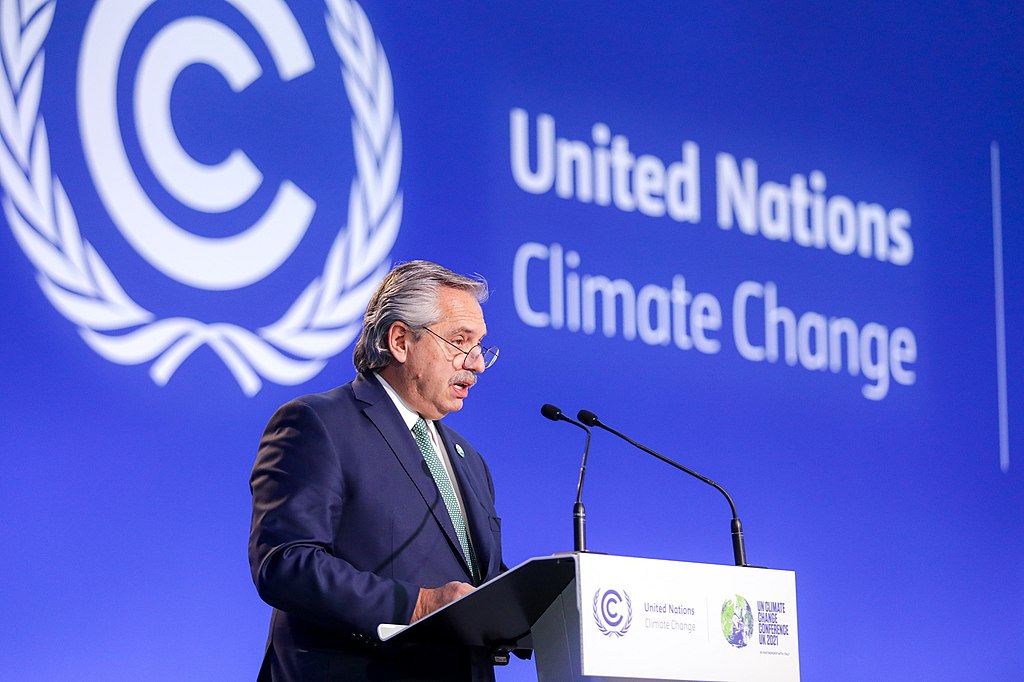
Curbing global warming to the 1.5 C° threshold requires a sizable 45 percent cut in global greenhouse emissions by 2030. Lagging behind the Paris Climate Agreement pledges, countries are using the subsequent editions of Conference Of the Parties (COPs,) tenets of the United Nations Framework Convention on Climate Change, as vehicles to chart new courses for global climate action. Because COPs act as the ‘supreme decision-making body’ of the Convention, this could potentially have widespread geopolitical implications.
The MENA region is a central player in these efforts as the breakthrough launch of the loss and damage fund occurred in Egypt. The novelty of this fund comes as a safety cushion for BRICS, G20, and the African Union from missing gaps in climate financing architecture, otherwise unfulfilled by the Green Climate Fund, The World Bank, The International Monetary Fund, and The United Nations Environment Programme. A close look at perceived regional leaders for climate action such as the UAE, Saudi Arabia, Egypt, and Morocco reveal a key finding: climate diplomacy drives national climate strategies whilst shaping new dynamics for regional engagement.
The Saudi, Moroccan, and Emirati climate resilience blueprints mark each regional stakeholder’s enthusiasm for energy transitions. In line with Vision 2030, the Saudi Green Initiative (SGI), a multi-sectoral program, aims for net zero carbon emissions by 2060 through the use of wind, solar power, and green hydrogen. The updated ambitious NDC targets and SGI are the bulk of Saudi’s Circular Carbon Economy National Program. In 2021, the Kingdom showcased ambitious decarbonization pledges by promising a doubling of its greenhouse gas (GHG) reduction capacity. Making the plan’s carbon drawdown capacity a close 278 million tons of CO2-equivalent removal by 2030. Energy transition is a national strategic policy shared with other Maghreb countries. Low-carbon emissions and climate-resilience are key drivers for Morocco’s national policy. Coal power plant removal is central to Moroccan energy transition. By 2050, coal-fired plants will be removed, and replaced by 2400 megawatts (MW) of natural gas power plants to be launched by 2030. These efforts are bringing Morocco closer to compliance with the SDG goals.
With the UAE’s successful bid to host COP28 underway, Emirati climate blueprints, including decarbonization by 2050, green hydrogen production, and energy mix diversification are gaining momentum. Another strategy used by the Emirates to spur a greening of the private and public sectors alike is the issuance of Green bonds. Abu Dhabi’s governorate was the first to reward environmentally aware investors through tax cuts incentives since 2017.
In display of the UAE’s willingness to weave in climate diplomacy into its policy framework, Dr. Sultan Al-Jaber, COP 28 president-designate, chaired the 7th Ministerial meeting on climate action (MoCA). According to Al-Jaber, the equitable energy transition model and its successful implementation are no longer exclusive to the UNFCCC system. In other words, fast-tracking the global energy transition, fixing climate finance, and upholding a human-centered-approach to climate adaptation are equally domestic staples of national policy. Climate diplomacy extends to the foreign policy portfolio as the UAE shepherds build bridging among the various stakeholders at COP28.
Middle Eastern Climate Diplomacy & Global Engagement
COP28 stands out from previous editions, notably through the egalitarian marketing it is projecting. An Abu Dhabi official communiqué reads the “special focus on the Global South and countries most vulnerable to the effects of climate change.” UAE leadership is intentional about shifting focus from western-centric cooptation of climate diplomacy. COP28 organizers are mobilizing around a “major course correction” in climate negotiations. Amidst G20’s recent expansion and the enlargement of BRICS, the MENA region is propelled to the forefront of a new climate diplomacy era marked by multipolarity. Climate diplomacy is a dynamic portfolio fostering UAE’s strategic partnerships with prominent climate stakeholders, and future COP30 host, Brazil. On October 4th, H.H. Sheikh Abdullah bin Zayed Al Nahyan, Minister of Foreign Affairs, met with his Brazilian counterpart Mauro Vieira in Brasilia. Both agreed that climate cooperation and renewable energy remain core themes for the development of bilateral UAE-Brazilian ties.
The enlargement of diplomatic overtures between BRICS and the articulation of new regulatory pathways for environmental governance are rightfully deserving of acclaim, however, they remain insufficient to fully solve pending global climate issues. If global fossil fuel dependency continues unabated, it is unclear how the 2030 Sustainable Development Goals (SGDs) and 2050 net zero carbon global objectives will come to fruition. At its core, global environmental governance is fractured by this fundamental dilemma between scale and speed. The appointment of Dr. Al Jaber as President-Designate of COP28 illustrates this underlying difficulty in decoupling sustainable leadership from the fossil fuel industry.
Although COP28 is facing a lot of scrutiny to deliver, its significance in democratizing access to climate diplomacy for middle-range and developing countries should not be understated. And the MENA region has a significant role to play in the advent of this new-age climate diplomacy.
Aya Kamil (she/her) is YPFP’s 2023 Rising Expert for the Middle East and North Africa. She is a 2022-2023 James C. Gaither Fellow at Carnegie Endowment for International Peace.
 Charged Affairs
