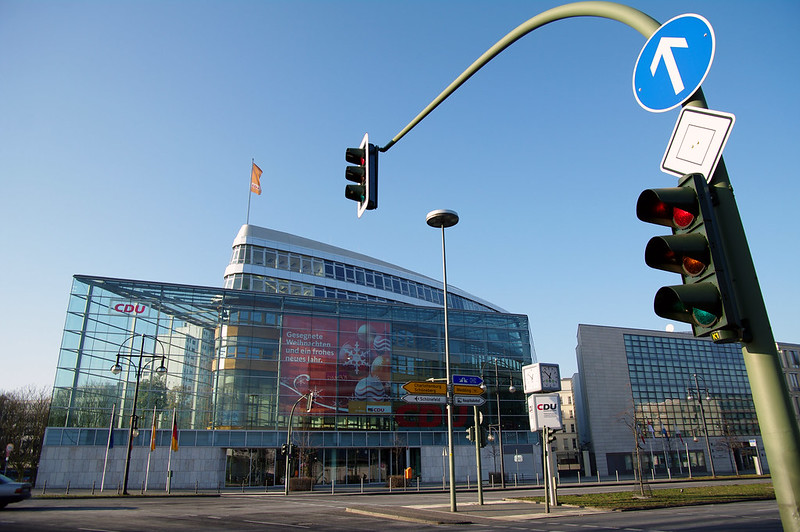
By Noah DeMichele | Rising Expert for Europe | November 12, 2023 | Photo Credit: Flickr
In April 2023, Kai Wegner of Germany’s Christian Democratic Union (CDU) became Berlin’s first conservative mayor in over two decades following a revote of Berlin’s chaotic September 2021 elections. In a vote by party members, Franziska Giffey’s Social Democrats (SPD) opted to unite with the CDU in a grand coalition with Wegner at its head, while the environmentally-focused Greens and the socialist Left Party were ejected from the government coalition. The CDU leading Berlin is a blast from the past, as is their vision for the city’s transportation policy, which threatens to derail the progress the city has made in sustainable transport in favor of outdated auto-centric policy.
Campaign signs reading “Berlin is for everyone, including car drivers,” and “25% fewer parking spots? Not with us!” indicated the pro-car policy the CDU would adopt in Germany’s capital. Promises from CDU leadership give the impression that their proclivity for the car will not come at the expense of other, more sustainable means of transportation — like public transit or cycling infrastructure. Indeed, Wegner publicly advocates for improvements in all means of transportation.
However, Wegner has also given special consideration to automobiles, arguing that “Berliners were tired of policy being made unilaterally against the car.” His intentions prove to be incompatible, as CDU policy actively derails the improvements Berlin has made to sustainable mobility, prioritizes cars over people, and takes backwards steps in urban transport, metropolitan policy, and efforts to promote sustainability.
In 2018, the Berlin government, then led by the SPD, passed the Mobility Act, which strove to advance eco-mobility, such as pedestrian traffic, cycling infrastructure, and public transit in the city. The plan was to help move Berlin towards its climate goals while helping to create safe, people-oriented streets and public spaces.
Yet, the updated draft by Berlin’s new transport senator, Manja Schreiner of the CDU, has reportedly slashed statements that sought to significantly reduce individual motorized traffic and gutted an entire section on new mobility, which included regulations on e-scooters, parking space management, and a goal for a city center free from combustion engines. The elements of the act representing 21st-century best practices for urban mobility, which would help Berlin achieve its ambitions to be climate neutral by 2045, have been erased.
Further, in June, Schreiner announced a moratorium on the construction of new bike paths in the city. The announcement brought thousands of cycling protesters to Berlin’s streets, eventually prompting Schreiner to green light 16 of the 19 bike paths on hold. Protesters in Berlin have also come out against the extension of the A100 highway, which would cut through the popular Friedrichshain neighborhood, threatening to wipe out 21 cultural institutions while subsuming prime real estate in a city already suffering from a housing crisis. The decision on whether or not to extend the A100 ultimately lies with the federal government, yet, with the CDU leading Berlin, there is unlikely to be any pushback from the city. The previous coalition of the SPD, Greens, and the Left opposed the further construction of the A100.
The political division on transport in Berlin is particularly stark when viewing a voting map from the 2023 elections. Within the Ringbahn, Berlin’s circular rail network marking the inner city, Berliners overwhelmingly voted for the Greens’ vision of transport policy grounded in public transit, cycling infrastructure, and sustainability. These are also the neighborhoods where much of Berlin’s cycling infrastructure is and where the A100 highway would be built. Meanwhile, the CDU — who received only 28 percent of the citywide vote — gathered much of their support from Berlin’s outer areas, where the use of cars is more prevalent and where progressive urbanism may have less of a draw.
City policy that keeps cars atop transport hierarchies is bad city policy. For safer, more sustainable, and just plain happier cities, urban transport policy needs to deprioritize cars and invest in the transport modalities of the future. Berlin was on the right track; now it’s going backward.
Berlin needs only to look at some of its neighbors to get its inspiration back. In Paris, Mayor Anne Hidalgo has led the charge to pedestrianize large swaths of the city’s center, leading her to win reelection in 2020 by nearly 20 percent of the vote. Copenhagen meanwhile continues to invest in cycling paths while reducing parking spaces in the city. These policies have, over time, made cycling the preferred method of transportation in the Danish capital by a wide margin. In Barcelona, the central Eixample district is slated to become nearly car-free over the next ten years, a move that will turn 21 streets into public plazas. Meanwhile, across the Atlantic, New York has introduced congestion pricing in an effort to fundraise for mass transit and disincentive car commuting into Manhattan.
Berlin’s new coalition agreement strives to make Berlin a “pioneer in climate protection” and pledges to expand public transportation and increase pedestrian areas. To deliver on these promises, the CDU needs to abandon the car-first transport policies it has been advocating for in Berlin and begin to advance urban mobility efforts that are sustainable and human-scaled.
Noah DeMichele is YPFP’s 2023 Rising Expert for Europe. He is a master’s student at George Washington University’s Elliott School of International Affairs where he concentrates on transatlantic relations and international security.


 Charged Affairs
