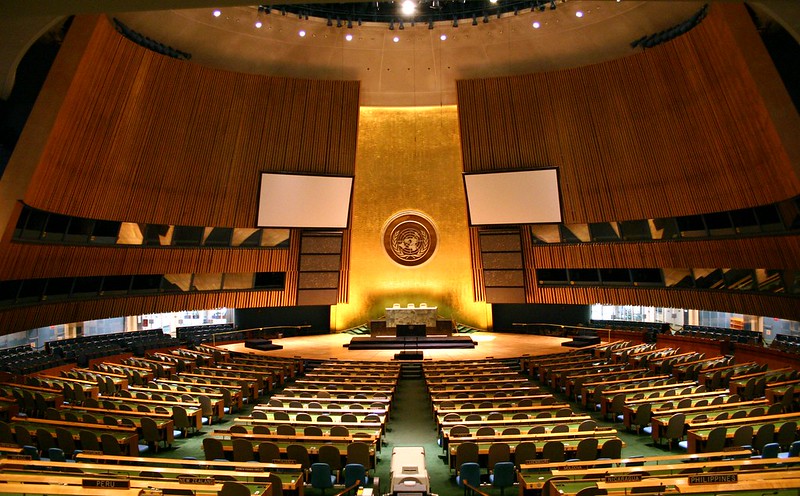
By Giulia Di Donato | Rising Expert for Geostrategy | November 8, 2023 | Photo Credit: Flickr
This year marks the mid-way point of the implementation of the 2030 Agenda for Sustainable Development, a plan of action signed in 2015 by UN member states to strengthen global efforts and ensure prosperity for people and the planet. With only 15% of the targets set for the achievement of the 17 Sustainable Development Goals (SDGs) on track, there are concerns about the potential to meet the 2030 deadline. To mark the beginning of a new phase of accelerated progress and transformative actions towards the SDGs, on September 18 and 19, the United Nations Secretary-General António Guterres convened the world leaders in New York for the SDG Summit, a two-days high level forum taking place during the 78th session of the United Nations General Assembly (UNGA). The Summit was designed as a platform enabling world leaders to present concrete plans for implementing the SDG Agenda and achieve its goals by 2030. Additionally, leaders were expected to endorse a high-level Political Declaration, reaffirming their unwavering political commitment on the 2030 Agenda.
Evaluating the efficacy of this high-level forum requires a careful examination of whether its initial intentions, objectives, and anticipated outcomes align with tangible commitments and achieved results. World leaders were asked by UN Secretary-General to submit a plan (National Commitment to SDG Transformation) containing concrete commitments to accelerate the achievement of the SDGs, including (i) priority transitions and areas for investment that will help maximize progress across the SDGs; (ii) a national benchmark for reducing poverty and inequality by 2027; and (iii) steps towards strengthened national planning and institutional frameworks to support progress in these areas. Moreover, the Secretary General expected Member States to demonstrate greater support for developing countries and reach by September an agreement on a $500 billion plan (SDGs Stimulus). Guterres also stressed the need to restate and reinvigorate all states’ commitment towards the reform of the global financial architecture.
Today, only 32 countries presented and registered their concrete commitments to achieve the implementations of the SDGs. Despite the successful adoption of the Political Declaration , the document only contains vague commitments and repeats what has been already incorporated in the 2030 Agenda for Sustainable Development and other high level commitments. While the meeting marks an important step in ensuring that world leaders commit and agree on the need to achieve the targets set in 2015, no concrete and remarkable actions have been taken. Without reflecting principles, values, ambitions and policy goals into national strategies and policies, the declaration is not likely to meet the expectations and deliver substantial results.
Regarding the SDG stimulus, the Political Declaration states that member states “welcome the Secretary-General’s efforts to address the SDG financing gap through an SDG stimulus” and “will advance the Secretary-General’s proposal, in a timely manner through discussions at the United Nations as well as other relevant forums and institutions, to tackle the high cost of debt and rising risks of debt distress, to enhance support to developing countries and to massively scale up affordable long-term financing for development and expand contingency financing to countries in need.” Considering that existing pledged funds still must find their institutional and financial framework and arrangements, like the Loss and Damage during the UN Climate Change Conference (COP27), when and how the SDG Stimulus will be operational is hard to predict.
The SDG Summit perhaps succeeded most at mobilizing citizens, activists, grassroots movements and NGOs around the world. In June 2023, there was an informal stakeholder dialogue on the zero draft of the Political Declaration where stakeholders and civil society organizations had the chance to provide their inputs. Moreover, in the wake of the Secretary General’s invitation to involve the civil society in the Summit preparation, national stakeholders launched a slew of projects and policy advocacy initiatives at national level to request that political leaders and decision makers reinvigorate their commitments towards the achievement of the 2030 agenda. As co-founder of Officine Italia, a third-sector Association with the goal to transform Italy’s trajectory through intergenerational dialogue and youth empowerment, I have been personally involved in one of these policy advocacy initiatives. In partnership with the Italian Climate Network and the Rome Hub of the WEF Global Shapers, we released a Policy Brief to recommend concrete actions and policies for Italian decision makers to enhance youth involvement in the achievement of the SDGs .
Some of these local initiatives have been presented during the SDG Action Weekend that consisted of the SDG Mobilization Day (16 September), and the SDG Acceleration Day (17 September) at UNHQ in New York. However, the engagement of the civil society followed a business-as-usual path. These events have been isolated from the main high-level dialogues and discussions that took place during the High Level Week, and they were not linked to the decision-making and negotiation process of the UNGA. Considering the weak engagement and political commitment of political leaders, the contrast between speeches and panels taking place during the UNGA and the enthusiasm shown by the civil society and youth groups during the previous weekend was even more remarkable.
There is another important aspect to be considered to assess the results of the SDG Summit. The UNGA is one of the most public and well attended global forums, and it has been usually used as a platform by the world leaders to present their foreign policy objectives, development assistance commitments, and international obligations. While developed nations are often under scrutiny to demonstrate their contributions, the UNGA offers a significant opportunity for developing countries not included in the G7 and the G20 to amplify their voices and advocate for their interests on the global stage. In essence, the UNGA functions as a barometer, gauging the state of international relations and global cooperation. Thus, a closer examination of the happenings during the Summit can provide insights into the prevailing diplomatic atmosphere at the international level.
The messages conveyed by leaders through their speeches and the notable presence or absence of key figures have sent unmistakable signals. For instance, the absence of key leaders (namely, four of the five permanent members – or P5 – of the UN Security Council) at the General Debate sessions underscores the limited focus and political dedication toward realizing the SDGs and sustaining a meaningful international dialogue on the matter.
Moreover, the speeches themselves display the minimal value that some countries place on prioritizing the SDGs and the overarching vision of the 2030 Agenda. For instance, we can refer to the speeches delivered by Italy’s Deputy Prime Minister and Minister of Foreign Affairs, Antonio Tajani, at the 2023 SDG Summit, as well as the statement by Italian Prime Minister Giorgia Meloni at the UN General Assembly. Both predominantly emphasized issues related to the political instability and insufficient economic development of the African Continent, which have led to an escalating surge of unregulated and substantial migration flows and human trafficking towards Europe via Italian shores. It is clear that the focus of these speeches was on domestic concerns that are currently at the forefront of Italy’s national discourse, targeting a primarily domestic audience, not global issues of critical importance such as the SDGs.
In stark contrast, several developing countries took to the international stage and asked for more recognition in the global arena and UN decision-making processes. One week before the SDG Summit, leaders of the Group of 77, the largest intergovernmental organization of developing countries in the UN, and China met in Cuba. The Havana Declaration, signed after the summit, reaffirms their commitment to strengthen the unity and solidarity of the Group in order to achieve its objectives and to reinforce its role in the current international context. The declaration clearly calls out developed countries and their failure to fill existing gaps between developing and developed countries, reiterating the crucial role of Official Development Assistance for the Global South, underlining the need for developed countries to fulfill their historical commitment, as well as reinforcing the capacity of international Financial Institutions.
Leaders of developing nations participated in the SDG Summit with sentiments of frustration and disappointment due to the scarce support and cooperation demonstrated by developed countries. Prominent leaders such as Mia Mottley, Prime Minister of Barbados and champion of the Bridgetown Initiative , and Gustavo Petro Urrego, President of Colombia , emphasized this dichotomy through several critical points. These included the imperative for a fairer representation of developing and vulnerable nations within the United Nations, the urgency of undertaking substantial reforms, and the ethical responsibility of developed states to bolster the Global South’s endeavors in their development, and climate adaptation and mitigation strategies, especially by respecting their commitments towards existing pledged funds.
Other fora and dialogues that took place during the High Level Week confirm this analysis. For instance, the Climate Ambition Summit took place on September, 20 and allowed member states to showcase their results and reinforce their commitments (in particular, their Nationally Determined Contributions) towards the achievement of the objectives set by the Paris Agreement. This forum involved a diverse group of leaders from local and national governments, businesses, and financial institutions, that have responded positively and ambitiously to the concrete ‘asks’ made by the Secretary-General in his Acceleration Agenda, a clear set of actions and principles needed from government, business and finance leaders to accelerate their efforts to cut emissions and deliver climate justice. However, only 5 countries from the G20, the only ones that accelerated their commitment towards climate action, have been invited to attend the meeting , and among the participants, only few countries announced renewed commitments, with the biggest polluters being the absent. In particular, the absence of the USA, China and India clearly show the obstacles to reach a global and ambitious commitments towards climate action.
Similarly, the High-level Dialogue on Financing for Development followed up on the implementation of the Addis Ababa Action Agenda. After the Paris Summit for a New Global Financing Pact held in June 2023, this dialogue was designed as a platform for UN Member States and other stakeholders not only to reinvigorate international commitment to the Addis Agenda, but also to move some steps forward the much-needed reform of the global financial architecture. However, after the weak results of the Paris Summit and the G20 in India, the Dialogue failed at achieving new milestones and relevant actions to increase climate financing and scale up investments towards the SDGs, ensuring that developing countries are not left behind.
The implementation of the 2030 Agenda, like any sort of commitment and achievement at international level, requires some crucial preconditions: tolerance, dialogue, peace and stability. However, the most relevant aspect that clearly emerged from the SDG Summit is the insufficient political will of the major powers to reinforce the international dialogue and cooperation that is much needed to work towards the same direction and implement transforming policies (drastically reduce CO2 emissions, commit and respect the pledges to support financially developing countries, stop the proliferation of fossil fuels, only to name a few).
The COVID-19 pandemic and the war between Russia and Ukraine inflicted a severe setback to the achievement of the SDGs (some targets worsened in the last 3 years). In particular, the ongoing Russia-Ukraine war and the escalated conflict taking place in the Gaza strip between Israel and Hamas are not only threatening the global stability but also elevate the risks of a nuclear war and broader international conflict. At the same time, minor regional conflicts, military coups threatening or replacing democratic regimes, civil wars and unrest in other regions are posing significant hurdles to the global pursuit of the SDGs. These challenges not only jeopardize the possibility to achieve concrete results during the Summit for the Future and the Biennial Summit on the global economy in 2024, but also divert the global community’s focus away from the imperative of embracing the transformative changes envisaged by the 2030 Agenda. This is why it is even more important for those developed nations that are not directly inflicted with these issues to take the lead on achieving the SDGs and champion ambition solutions to the climate crisis.
Giulia Di Donato(she/her) is YPFP’s 2023 Rising Expert for Geostrategy. She is an incoming UN/DESA Fellow and Policy Officer at UNDP Vietnam.
 Charged Affairs