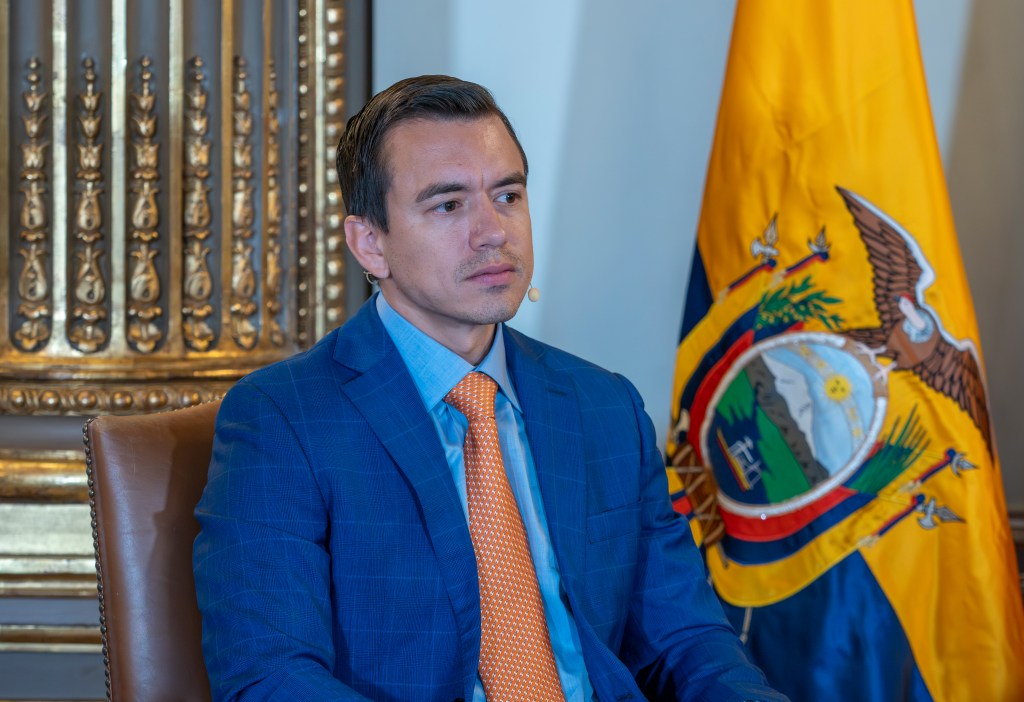
By Gil Guerra | Rising Expert on Latin America | June 8, 2024 | Photo Credit: Flickr
The most consequential period of Ecuadorian President Daniel Noboa’s term has passed and he appears to have emerged with his political strength largely intact.
April saw an astounding raid by Ecuadorian police forces into the Mexican embassy to arrest former Ecuadorian vice president Jorge Glas, who was granted asylum despite being wanted on corruption charges in Ecuador. A few weeks later, Ecuadorians also voted in a critical referendum on Noboa’s security and economic plans for the country.
Noboa and his supporters point to a victory in nine out of eleven questions in the 2024 referendum—a sign that the Ecuadorian public approves of his aggressive tact to combat crime and corruption. His detractors, however, have focused on the two questions Noboa lost in the referendum as well as the overwhelmingly negative regional reaction to his raid to make the case that his position has been weakened.
A closer look at the referendum’s result and subsequent polling suggests that Noboa’s position remains strong for now, with a few important caveats.
Implications of the 2024 Constitutional Referendum
In January, Ecuador descended into a period of heightened violence following an attack on a television broadcasting station in Guayaquil by armed gunmen. In response, Noboa declared a temporary state of emergency and called for a referendum in April to alter the Ecuadorian constitution, giving the state increased powers in combating organized crime.
Of the eleven questions on the ballot in the April referendum, nine were related to security measures and two were related to economic reforms. The nine security questions, on average, passed with a “yes” vote of 65%, while the two economic questions failed with only 32% combined public support.
Table 1 – 2024 Ecuador Security Referendum Questions
| Question | Description | “Yes” Vote % |
| A | Allows armed forces to take on a greater role in combating organized crime | 72.26% |
| B | Makes Ecuadorian nationals subject to extradition. | 64.35% |
| C | Creates specialized courts to specifically address constitutionally protected matters, such as habeas corpus | 59.93% |
| D | Allows Ecuador to use international arbitration to resolve commercial and contractual disputes with foreign investors or private individuals | 34.82% |
| E | Legalizes fixed-term and hourly labor contracts | 30.47% |
| F | Gives military permanent oversight of arms control along prison transportation routes | 69.68% |
| G | Increases penalties for organized crime-related offenses | 67.35% |
| H | Mandates that those convicted of organized crime offenses carry out the totality of their sentence in prison | 66.69% |
| I | Criminalizes civilian possession of firearms and ammunition reserved for military or police use | 63.91% |
| J | Allows weapons and their component parts seized in criminal investigations to be immediately ceded to police or the armed forces for their sanctioned use | 64.07% |
| K | Gives the state ownership of seized illicit assets | 61.01% |
| Source: Consejo Nacional Electoral, “Conoce las 11 preguntas para el Referéndum y Consulta Popular 2024 |
In total, across all questions, the average “yes” vote was 59%. If taken as an indicator of approval, it is higher than the 52% of votes Noboa won the election with in 2023, but lower than his 74% approval rating recorded in a poll taken before the raid.
Noboa’s public support improved dramatically in areas where crime has increased, as in the port towns around Guayaquil, where the Center for Strategic & International Studies has reported a surge in homicide rates. Noboa narrowly lost the province of Guayas in 2023, garnering 48% of the vote there. In 2024, his referendum passed with an average “yes” vote of 62%, a dramatic rise in support reflected in other provinces along Ecuador’s hard-hit Pacific coast.

The results issue an important warning for Noboa. Only two of his security proposals (A and F) passed in every province, and even in his strongest provinces, his economic proposals struggled to garner 40% of the vote—they often fell far shorter. In Noboa’s strongest province, Tungurahua, only 35% of voters approved his labor reform proposal.
Despite having majority support for his security policies, Noboa’s economic proposals have thus far shown to be a significant area of weakness his political opponents will surely capitalize on. Most recently, polling indicates that Noboa’s support for the increase in Ecuador’s Value Added Tax has been especially damaging to his popularity.
Looking to the 2025 Election
The astronomical 85% approval rating Noboa enjoyed at the outset of his crackdown on organized crime in Ecuador in January was unsustainable. Ecuadorian politics is highly polarized, and no president in the 21st century has won an election with more than 57% of the vote.
Noboa’s referendum passing with 59% suggests a decently strong political foothold ahead of his 2025 reelection bid. This number is also consistent with a recent poll showing that more than half of Ecuadorians approve of the raid on the Mexican embassy. What this tells us: despite costing him legislative ground after the left-leaning Citizen Revolution Movement party ended its support for his governing coalition, his popular base is stronger than it was in 2023. Noboa has also mostly weathered the international consequences of the raid on the Mexican embassy.
Mexico and Ecuador are litigating their dispute in the International Court of Justice. The Court’s first ruling declined to grant Mexico’s request for preliminary orders, which would have immediately ordered Ecuador to protect Mexican diplomatic property on the grounds that the request did not carry sufficient urgency.
Despite regional condemnation and a formal rebuke by the Organization of American States (OAS), only the regional pariah states of Nicaragua and Venezuela, which are functional dictatorships and not part of the OAS, formally took steps to break off relations with Ecuador. Mexico’s diplomatic power in the region has been hampered by outgoing Mexican president Andres Manuel Lopez Obrador’s habit of picking fights with other regional leaders, which could limit how much other states want to pursue further multilateral punitive measures against Ecuador.
On the domestic front, according to leading security experts, the rift with Mexico is also unlikely to have new ramifications for coordination on bilateral anti-crime measures, given Mexico’s low participation in such efforts.
This matters because Noboa’s popularity hinges on his ability to fight organized crime in Ecuador. Now that he has a definitive mandate, voters expect him to make significant progress in stabilizing the country—something that is easier to promise than to deliver.
Gil Guerra is the 2024 Rising Expert on Latin America and an Immigration Policy Analyst at the Niskanen Center. His work has been cited in The Wall Street Journal, POLITICO, The Economist, The Boston Globe, The Miami Herald, and The Dispatch.



 Charged Affairs