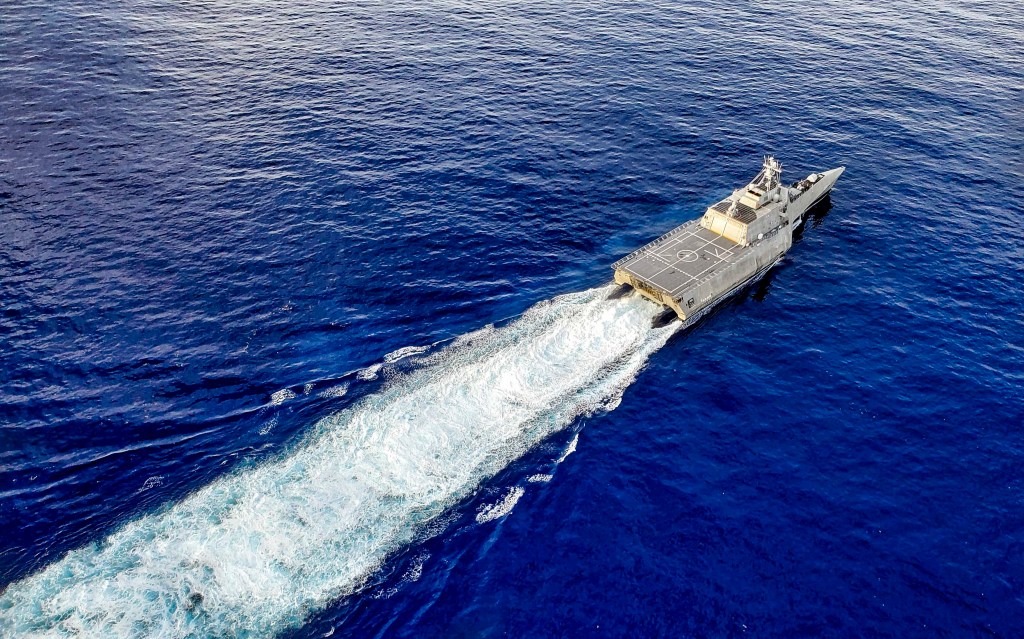
By Laurel Baker | Rising Expert on Geostrategy | July 2, 2024 | Photo Credit: Flickr
Recently, Arctic dialogue buzzed with murmurings that Russia might withdraw from the United Nations Convention on the Law of the Sea (UNCLOS)––the regime governing resource extraction, territorial delineations, freedom of navigation, and other maritime concerns. Worries compounded when Moscow declared that it does not recognize the United States’ new extended continental shelf (ECS) claims––a state’s coveted territory beyond its unconditional 200-nautical-mile exclusive economic zone. ECS submissions represent states’ attempted nationalization of marine assets to expand governments’ extractive and ecological conservation efforts and project naval power. In this case, the United States’ northern asserted limits avoid Russia’s claims but overlap with Canada’s.
Then why did Moscow reject the United States’ long-awaited ECS delineation––and why is it increasingly voicing dissatisfaction with the Convention? Because the United States is not a party to UNCLOS. While they largely abide by its regulations, such as the territorial parameters in Article 76, the United States’ claims do not defer to the United Nations Commission on the Limits of the Continental Shelf, which generally evaluates and recommends solutions to ECS disputes. This means that the bilateral US-Canadian ECS mediation will simultaneously circumvent and mimic the technical and negotiatory procedures typically provided by the UN. From Moscow’s perspective, these and other cherry-picked practices around UNCLOS provide (nominally) legal ammunition to refuse US claims. It is time for the United States to nullify this excuse and ratify UNCLOS.
While the Biden administration and a string of military affiliates favor ratifying UNCLOS, US Senators have long resisted signing the Convention. Anti-regulation conservatives under President Reagan appealed to preserving free-market autonomy, expressed bureaucratic skepticism and fears of “Third World” coalitions undermining US supremacy, and rebuked the rule of the International Seabed Authority over deep-sea projects. Today, qualms include potential lawsuits over environmental malpractice, fears of regulations stifling innovation, and increased bipartisan interest in deep-sea mining in the face of a Chinese critical mineral monopoly. In short, US policymakers have been slow to release their clutch on what critics characterize as relatively unconstrained maritime activity afforded by absolute naval dominance.
Yet, why is it essential to ratify international agreements if the United States largely complies with their contents? A plethora of reasons. Foremost, credibility––the notion that a state will follow through with specific threats or commitments. Whether comprehensive or compartmentalized, states’ credibility uniquely substantiates voluntary international protocols like UNCLOS that rely practically on members’ mutual enforcement.
Granting these strategic conditions, other scholars have illustrated why Russia’s repudiation of UNCLOS on grounds of US hypocrisy could be either genuinely worrisome––e.g., in the Arctic, fostering an accelerated military buildup, unregulated extraction, and curtailed trade passage––or merely performative. Even if some Russian political elites laud UNCLOS and support Moscow adhering to international custom, others’ inflammatory rhetoric and the uncertainty it causes does undoubtedly add to a larger, disturbing precedent; the Kremlin has justified exiting important agreements due to US nonparticipation before, especially those relating to strategic stability. Russian officials cited the United States’ lack of formal participation in the Comprehensive Nuclear Test Ban Treaty in Moscow’s 2023 withdrawal, following earlier collapses of the Intermediate-Range Nuclear Forces Treaty and the Anti-Ballistic Missile Treaty (among others). The catch is that the United States defended its legal withdrawal or absence from certain treaties in part through Russia’s own violations and hollowed credibility. Similarly, Moscow’s critiques of US sanctimony around UNCLOS are themselves ironic; what matters is that this negative credibility loop of reciprocally operating outside of official bi- and multilateral procedures proliferates and escalates real threats.
This destabilizing pattern of shedding mutual obligation highlights that Washington’s perceived reluctance to yield autonomy to strengthen various multilateral agreements, coupled with administrative upheaval, embitters challengers and disillusions allies. Indeed, US inconsistency is counterproductive to allied security interests––at sea, favoring unilateral action over multilateral measures compromises attempts to collectively stymie or redress attacks on critical infrastructure, environmental degradation, nuclear proliferation, terrorism, and other maritime national security issues. Conversely, ratifying a foundational accord like UNCLOS bolsters US credibility in light of its contested commitment to liberal multilateral governance, formally countering accusations of opportunism or selectivity and authoritatively rejecting such behavior from adversaries and allies alike. The defining tension of this debate therefore lies in an outsized and outdated fixation with vaguely defined “sovereignty” in shared waters while striving to responsibly uphold a so-called “rules-based” international order––characterized principally by participation in and compliance with international mandates.
Worth asking is why we should zero in on UNCLOS when the United States failed to ratify other foundational accords like the Rome Statute and Forced Labour Convention. While there are compelling arguments around the urgency of those and other cases, the United States currently has both the impetus and the means to accede to UNCLOS swiftly. That is, the Convention is disproportionately relevant to geopolitical venues likely to shape the next several decades––high-risk maritime operational theaters like the Indo-Pacific, supply chain choke points, and climatic and commercial nodes like the Arctic. Moreover, ratifying UNCLOS can be relatively easy due to redundancies in US law––it will not lead to a slippery slope of injuriously surrendering sovereignty. Instead, ratifying UNCLOS will boost allies’ confidence in the US ability to transcend domestic chaos and commit to stabilizing mechanisms as security environments deteriorate on several fronts. It will protect US interests near and far and, in reaping diplomatic benefits, encourage an enhanced prominence of and responsible deference to international authority. Despite its gaps and insufficiencies, acceding to UNCLOS is the easiest route to universally more secure US waters.
While it is true that ratifying UNCLOS will not totally resolve current or potential maritime disputes, nor fully address the admittedly imperfect concept of “credibility,” the bottom line is that the United States risks weakening its postures abroad and missing out on national security returns by not ratifying. Those who argue that the United States successfully works around UNCLOS without sacrificing preeminence in its maritime agendas overlook a critical point. If Washington wants to remain a respected leader in an increasingly multipolar world, it must visibly buy into the liberal norms and institutions it champions.
Laurel Baker is the 2024 Rising Expert on Geostrategy and a National Nuclear Security Administration Graduate Fellow at Pacific Northwest National Laboratory. Her work has appeared in the Wilson Center’s “Polar Perspectives” journal and The Arctic Institute’s newsletter, “The Arctic This Week.” Laurel’s views are her own and do not represent those of Pacific Northwest National Laboratory or the US Government.
 Charged Affairs