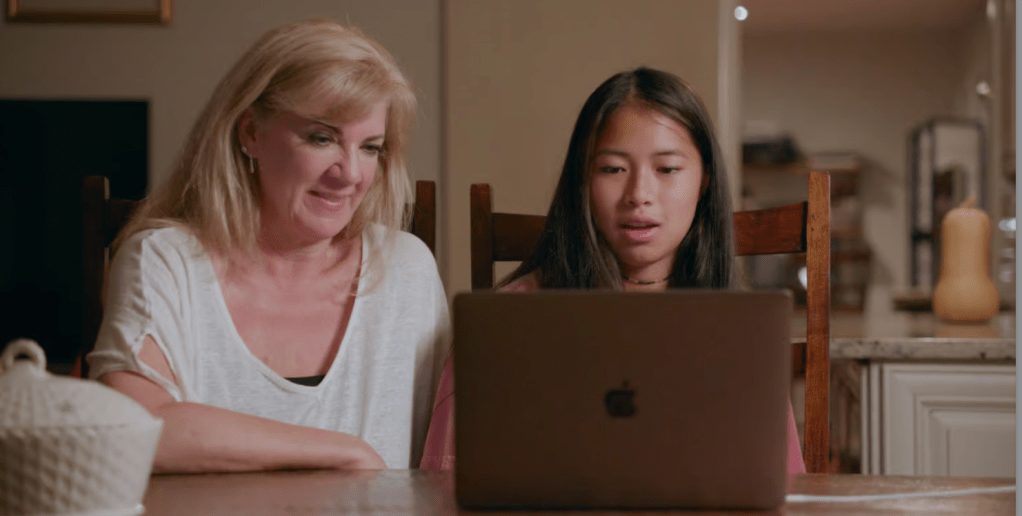
Intercountry adoption remains hyper-visible yet oversimplified in public discourse
By Mahli Knutson | Rising Expert on Human Rights | July 13, 2024 | Photo Credit: Netflix Media Center
Intercountry adoption has long animated television and news with celebrity adoptions, illicit adoption scandals, and humanitarian rescues. Adoption out of Asia—the most common birthplace of children adopted to the United States—has its roots in war. Global audiences followed Korean “war orphans” and Operation Babylift following the fall of Saigon in 1975, when babies were evacuated and adopted out of areas of active conflict. Since then, coverage of adopted children and their families continues to couple global calamity with family-building across borders.
These images make up an oversimplified public conversation around adoption that overlooks the complex experiences of adopted people. Celebrity adoption coverage in particular demonstrates how popular media sensationalizes intercountry adoption, usually focused on themes of motherhood and saviorism. One prime example is actress Angelina Jolie’s adoption of her son Maddox in Cambodia while filming there. Jolie reportedly skirted a series of bureaucratic processes when her friend at the time, Cambodian NGO leader Sarath Mounh, signed legal documents falsely claiming Maddox as his son and then transferring parental rights to Jolie in 2002.
Jolie’s adoption story demonstrates how family narratives are used to reduce public discourse to feelings around fit and unfit mothers and the dichotomy between “pro” and “anti” adoption stances. Coverage vacillates between valorizing Jolie’s decision to find a better home for young Maddox, (one of many babies in need in the developing country), and searching for “the truth” about potentially “stolen children.” This mirrors a larger framing around adoptions by famous women: the new mothers are either ‘saints’ for saving the child from a life of poverty and violence, or ‘villains’ for purchasing them. Maddox’s story serves mainly to highlight Jolie’s maternal heart through the process of adoption.
The YouTube-famous Stauffer family provided the ‘villainous’ foil in 2020 when they were lambasted on social media and in the news after reversing the adoption of their Chinese son Huxley. The family initiated this reversal, called “rehoming,” three years after Huxley joined the family, citing unexpected challenges in addressing his special needs.
Critics faulted Myka Stauffer, the family matriarch, for the move because she financially benefited from monetized YouTube videos featuring Huxley. Again, the spotlight was cast on motherhood, with little attention paid to the responsibility borne by James Stauffer, Huxley’s former adoptive father, or Huxley’s journey of adoption.
Defenders of the rehoming decision call out important shortcomings of the adoption and rehoming process, including the lack of support services for new parents. These shortcomings hint at a larger, systematic failure—and we need to probe deeper at which systems have failed.
Migration is one lens that could reframe adoption experiences with more nuance. The term “migrant” covers much ground, including anyone moving from their place of origin regardless of legal, cultural, and national affiliations. Yet it is seldom applied to the estimated 1 million children adopted internationally since World War II. Emerging scholarship from Critical Adoption Studies interrogates adoption in helpful new ways, yet the public conversation lags sorely behind.
Sometimes coverage cannot help but acknowledge—and even affect—the cross-border dynamics of intercountry adoption. Specific lanes of intercountry adoption have been banned following stories on particularly severe cases of child neglect. Russia halted intercountry adoptions in 2012 with the Dima Yakovlev Law, named for one Russian adoptee to the United States who died of heatstroke after being left alone in a car. The ban came on the heels of another Russian adoptee, Artyom Saveliev, being rehomed and put on a plane to Russia alone with no arrangements for his care upon return.
While such responses may seem like a step in the right direction, they do not push the conversation far enough. Bans following adoption scandals mirror the oversimplified public conversation on adoption as “for” or “against,” distracting from a holistic approach to adoption processes and its many hurdles.
A growing list of popular culture exceptions—television shows like The Queen’s Gambit and documentaries like Found and Twinsters—depict adoption being normalized and adopted youth increasingly consulted on how they wish to be portrayed to the world. Dominant media around adoption, however, uses family narratives to reduce public discourse to moral red and green lights around complex experiences of parenthood and adoption. This oversimplified public portrayal of intercountry adoption stunts our ability to recognize the full range of adoption experiences.
Mahli Knutson (she/her) is YPFP’s 2024 Rising Expert for Human Rights. She was adopted from China and is a graduate of the Harvard Kennedy School’s Master in Public Policy program and Middlebury College. She works to connect adoptees across generations and countries through writing and by volunteering with China’s Children International.

 Charged Affairs