Nicholas Castillo | YPFP Member | August 29, 2024 | Photo Credit: Flickr
The United States and its allies should provide exit polling and parallel vote tabulation (PVT) for Georgia’s October elections. This is not only reflective of the Georgian people’s aspirations but is also in keeping with U.S. interests, as free and fair elections in Georgia would help undo Tbilisi’s drift towards autocracy and Russian influence.
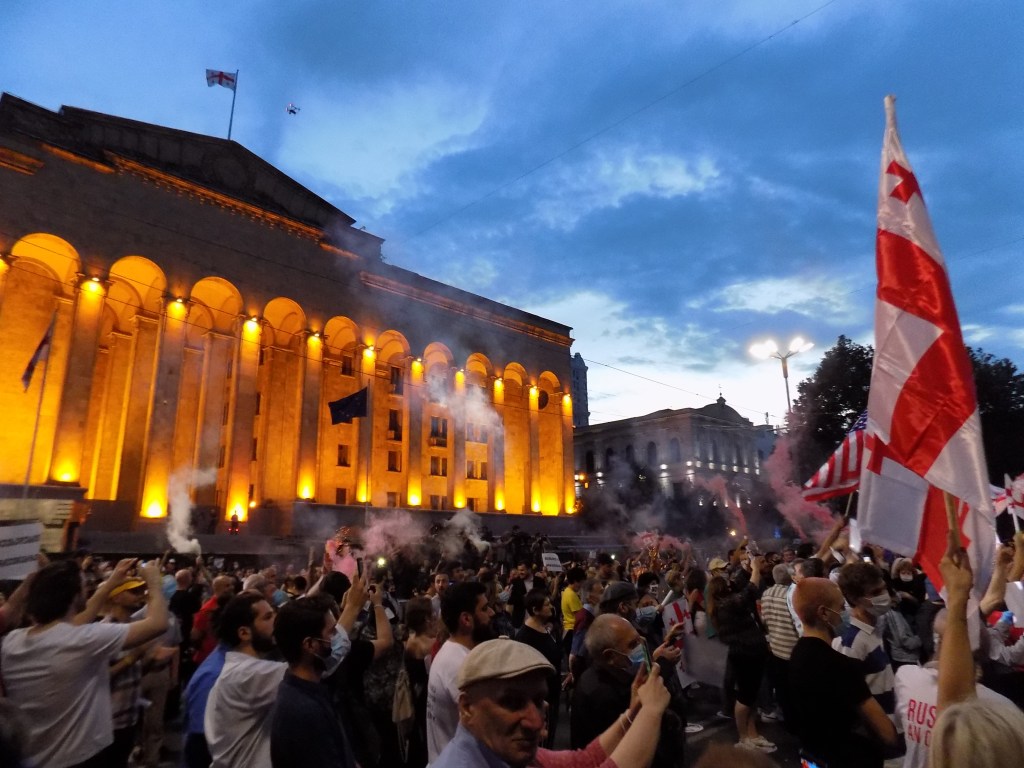
Western-Georgian ties have been on thin ice for years due to the ruling Georgian Dream (GD) party’s dovish stance towards Russia and its efforts at democratic backsliding. In March, relations soured even further between Georgia and its American and European partners. Despite over 70% of Georgians preferring a pro-Western foreign policy and widespread protests opposing the move, the GD party passed a law in March requiring non-governmental organizations (NGOs) that receive more than 20% of funds from abroad as an “organization acting on behalf of a foreign power.” Similar laws requiring NGOs that receive foreign funds to register as “foreign agents” have been passed in countries like Belarus and Russia and have helped persecute civil society there. Following the law’s passage, Washington and Brussels canceled over $100 million in annual government aid packages to Georgia, the United States began placing sanctions on Georgian elites, and the European Council released a statement placing Georgia’s long-running E.U. candidacy on a “de-facto halt.”
Georgia’s historically dysfunctional opposition has seized upon the issue of Western alignment to attack the GD party ahead of this fall’s elections. Various anti-GD groups have argued that Georgia is in a crisis and that recovering U.S. and E.U. ties, crucial for Georgia’s future, will only be possible if the GD party is removed from power.
Disregarding Georgians’ desire to integrate with the West, the GD party has mobilized social conservatism and conspiracy theories to pitch itself to voters. Georgian Dream has depicted itself as a guardian of traditional values, passing a law against “LGBT propaganda” this year. The party has also blamed crumbling Western relations on a global conspiracy referred to as “The Global War Party.” This cabal, the GD party argues, caused the 2008 Russo-Georgian War and the Russo-Ukrainian War and is now using local opposition parties to force another confrontation with Russia. In a country with strong, recent memories of war, GD has offered itself as the only thing standing in the way of another war with Russia.
There are signs that GD’s appeal may not be working. Recent polling demonstrates that non-GD forces stand a good chance of winning a majority, especially with Georgia’s smaller opposition parties rallying together into blocs. There are now four main opposition groups, with three being alliances of smaller parties. Pro-Western and democratic politics may still win in October.
But the prospect of an opposition victory relies on a free and fair election. Onlookers are increasingly skeptical of this possibility. GD has shown little regard for democratic norms, cracking down on Georgia’s civil society by way of the foreign agents law. The government also appears to be organizing intimidation campaigns and violent assaults on opposition activists. Most concerning, the party has stacked the election oversight committee with those loyal to the government. A German Marshall Fund report found significant cause for concern, saying “the role of observers and media will be constrained, if not eliminated. Political violence and arrests are anticipated… other shortcomings [have been] identified in the election framework and administration.”
This is where the United States can come in by providing exit polling and PVT. Exit polls can grant insight into how voters cast their ballots, while PVT counts how many ballots were issued to polling stations. Taken together, these strategies can produce solid independent estimations of an election’s real outcome that can be compared with any tally produced by official agencies. Organizations like USAID and the National Endowment for Democracy (NED) have supported free and fair elections in Georgia before, where they were crucial in the 2003 Rose Revolution that prevented the government of Eduard Shavardnadze from stealing a national election.
The United States has options in terms of how to do this work. Washington could directly work in Georgia through institutions such as USAID or NED. Additionally, the United States could work through – or partner with – other institutions, such as the Organization for Cooperation and Security in Europe (OSCE) or the United Nations. Non-governmental organizations may remain viable partners even if they are labeled foreign agents. This includes the International Society for Fair Elections and Democracy, a Georgian NGO the United States has partnered with in the past. Another NGO whose work the U.S. government could further enhance is the International Republican Institute, which announced in July it will send 20 individuals to monitor elections in Georgia in anticipation of October’s election.
If GD plans to falsify results, they might ignore any reliable number made public by outside organizations. Moreover, the participation of USAID or NED in election monitoring will likely be used by GD to argue they are facing foreign interference. Regardless, these initiatives are still powerful. Recently, in Venezuela, the government ignored monitoring results that pointed to an opposition victory. Opposition activists still seized upon those results, legitimizing themselves in the eyes of the world and the Venezuelan public. Something similar could play out in Georgia if GD chooses to ignore the people’s will.
The United States and its allies have re-configured their approach to Georgia. They have rightly done so in response to an increasingly hostile and undemocratic government that is out of step with Western liberal values. But the West should show it has not given up on Georgia. One of the most impactful ways to do that is to provide election monitoring this October, equipping Georgians with the information necessary to chart their destiny.
Nicholas Castillo is a member of YPFP and a Program Officer at the Caspian Policy Center. He holds a B.A. from George Washington University in Political Science and International Affairs, focusing on Eastern Europe, Eurasia, the Middle East, and conflict studies.

 Charged Affairs