Alexis Turek | Rising Expert on Indo-Pacific | September 18, 2024 | Photo Credit: Flickr
August marks the one-year anniversary of Cambodia’s historic transition of power where Hun Sen stepped down from his nearly thirty years as Cambodia’s Prime Minister and passed the reigns over to his eldest son, Hun Manet. With this milestone approaching, it is an ideal time to examine Manet’s first year in power and see what conclusions can be drawn about him and Cambodia’s future. While Manet is unlikely to institute massive reforms, especially given his father’s remaining influence in politics, his actions and policies this past year suggest that he could be a force for change in Cambodia. Manet’s approach to foreign policy so far suggests that renewed engagement between the US and Cambodia might emerge. New leadership in Phnom Penh presents a great opportunity to reverse the past decade of tension with the US and closer alignment with China.
Following the initial announcement of Sen’s succession plan, there was widespread speculation about the potential impact of Manet’s leadership. As a young, Western-educated leader, the first Cambodian to graduate from West Point military academy, many analysts wondered whether his international exposure had instilled in him a sense of democratic ideals. While few went as far as to suggest that he would revolutionize the country, there was hope that he would be a less authoritarian leader than his father, potentially leading to significant improvements in the lives of ordinary Cambodians.
Were this the case, it would be welcome news to the US, who has experienced a marked decrease in bilateral relations with Phnom Penh while the Southeast Asian state developed increasingly close ties with Beijing. In 2017, the Angkor Sentinel joint US-Cambodian military exercises were halted only a month after the first Gold Dragon joint exercise with China. After that, Cambodia demolished two US-built facilities at Ream Naval Base as part of a Chinese-backed construction effort. Ream Naval Base has been an area of focus for many analysts since the existence of a secret agreement between Cambodia and China was revealed, allowing China to use the base for 30 years for weapons storage and the docking of warships. The location of this base is of particular concern to China watchers, who see the basing agreement as a way for Beijing to protect its territorial and economic claims in the South China Sea, threaten US allies in Southeast Asia, and increase its influence over the Malacca Strait. While Cambodia and China have always enjoyed close relations, over the past several years they appear to have grown even closer they appear to have grown even closer over the past several years, sparking widespread concern.
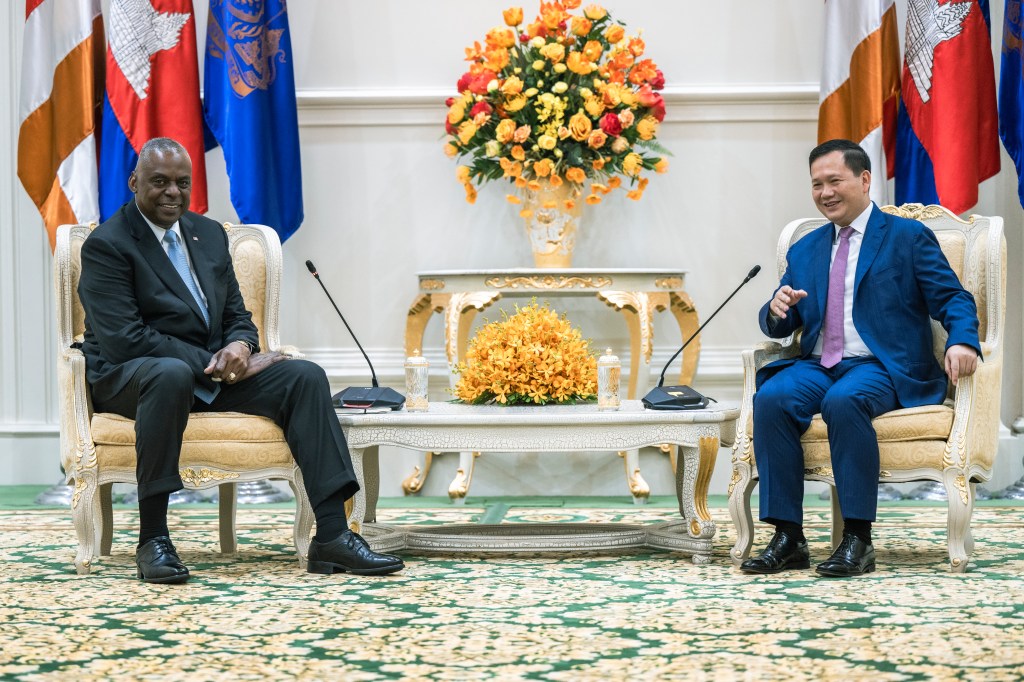
Although it is still early on in Manet’s tenure as Prime Minister, a few emerging trends indicate that he may be more inclined to balance with several states than bandwagon with China. The first trend is Manet’s increased focus on greater dialogue and cooperation with Washington. Meetings between top US and Cambodian leaders have occurred several times this past year, most notably between US Secretary of Defense Lloyd Austin, Hun Manet, Hun Sen, and Cambodian Defense Minister Tea Seiha. During the meeting, the ministers discussed ways to strengthen bilateral relations and support regional peace and security measures. Readouts from the meeting mention efforts to create joint training exercises for disaster management, United Nations peacekeeping operations, and de-mining and unexploded ordinance clearing. Secretary Austin also mentioned the possibility of allowing Cambodians to access US Professional Military Education programs.
If these efforts were carried out, they would provide an opportunity for increased engagement between the two militaries in a manner that would be less likely to cause concern amongst those in Cambodia who do not want to risk angering China. One of the biggest mistakes in recent US engagement with Southeast Asia is the suggestion that states must choose either the US or China. By focusing on engagement below the threshold of joint military exercises, the US can both enhance bilateral relations with the Cambodian military and appease more cautious elements of leadership in Phnom Penh.
Another positive trend in Cambodian foreign policy is Manet’s push for new bilateral economic and diplomatic agreements with European and US-allied states. Over the past year, Manet has visited several foreign leaders to discuss improving diplomatic and economic ties. One notable example was Manet’s visit to France, which concluded with the signing of a $235 million agreement promising aid and development assistance. During the visit, French President Emmanuel Macron reiterated support for Cambodia’s stance against Russia’s war in Ukraine, an area of political alignment between the two nations. Manet is also looking to develop better relations with other Asian states, beginning with South Korea. The two states announced a new “Strategic Partnership” in May, facilitating the creation of several new bilateral economic and military efforts. Creating new opportunities for foreign investment and bilateral trade is vital to Manet’s economic development initiatives. The United States should work to develop its own investment and bilateral trade initiatives with Cambodia in order to lessen its economic dependence on China and improve perceptions of the US within the state.
While the past year indicates that Manet may be altering Cambodian foreign policy, he certainly has not abandoned Cambodia’s partnership with China. Joint military exercises, diplomatic exchanges, and the docking of Chinese ships in the Ream Naval base have all continued. Manet even reaffirmed the “Diamond Hexagon” economic cooperation plan, in which China agreed to help enhance Cambodia’s technological industries and agricultural exports. The US cannot expect Cambodia to completely abandon its closest ally and most significant economic partner. Still, Manet’s first year in power suggests that there may be a chance for substantial changes to occur in the future. If the US truly wants to limit Chinese influence in Cambodia, it must develop a concerted policy plan to improve relations between our two countries and implement it sooner, rather than later.
Alexis Turek is the Indo-Pacific Rising Expert at Young Professionals in Foreign Policy. She is a D.C.-based researcher focused on the People’s Republic of China and Southeast Asia. Alexis graduated with an MA in Diplomacy and International Relations from Seton Hall University, where she worked as a Graduate Research Assistant at the Center for Foreign Policy Studies.

 Charged Affairs