Nicholas Castillo | YPFP Member | November 9, 2024 | Photo Credit: Mira of Kyiv
The rise of an ideology often hinges on real world events. Israel’s 1967 defeat of pan-Arabist regimes marginalized pan-Arabism and popularized a more ambitious and uncompromising Zionism for pro-Israel communities. Today, the war in Ukraine is enabling another ideological perspective: a post-colonial view of Eurasia that sees Russia as a colonial expansionist and embraces the West, especially the European Union. The battlefield is providing a space for Eastern European militants from the former Soviet Union to enact this ideology, giving it a sense of realism.
In Ukraine, a new generation of anti-Russian militants from former Soviet Union states are defending Ukrainian sovereignty against the latest instance of Russian expansion. The war has attracted substantial foreign fighters from former USSR republics, specifically Georgia, Belarus, and Chechnya, all of which are currently under pro-Kremlin regimes. More significantly, these volunteers are broadcasting anti-Russian, pro-Western, and pro-democracy material on social media, usually targeted at their fellow citizens back home.
Georgians
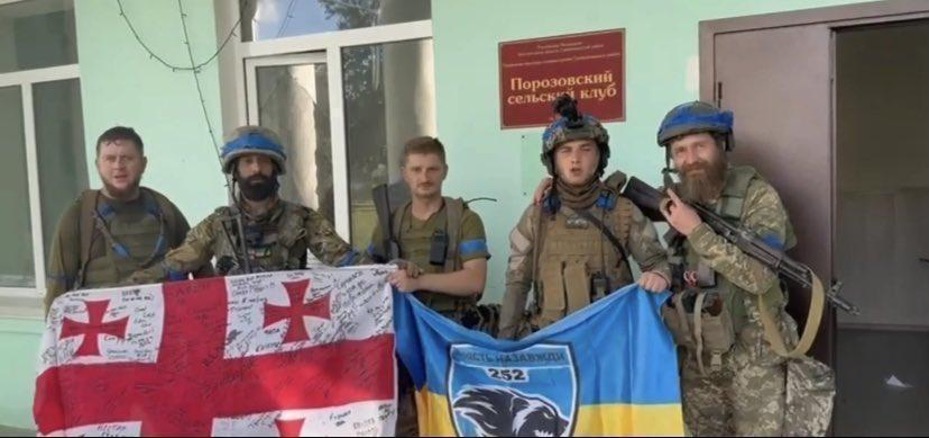
More than a decade after Russia’s invasion of Georgia in 2008, Georgian soldiers are now crossing into Kursk Oblast as part of Kyiv’s offensive into Russia. Many are part of the Georgian National Legion of Ukraine, which was active in Ukraine since 2014 and integrated into Ukraine’s armed forces in 2016. The specific number of Legion members is unknown and reported membership varies between 700 to 2,500. In August, a pro-Russian news service reported that at least 120 Georgian Legion fighters are active in Kursk.
At home, Georgia’s increasingly authoritarian government views the legion as a threat. The ruling Georgian Dream (GD) party and pro-government media have claimed legionaries were involved in plots to stage a coup and assassinate officials (neither of which materialized). According to Mamuka Mamulashvili, head of the Legion, a former advisor to former Prime Minister Mikael Saakashvili, and a veteran of the Abkhaz-Georgian and Russo-Georgian wars, the government has placed 300 Legion volunteers on a ‘wanted list’ implying their arrest should they return. Numerous opposition politicians, including Saakashvili, have publicly supported the legion.
The focus of GD on the legionaries likely only raises their profile in Georgian politics. GD is an increasingly unpopular party, polling roughly 35% in independent polls, and critics have attacked them as Russian assets. In contrast, according to former Ambassador Giorgi Badridze, a senior fellow at the Rondeli Foundation, “Almost everyone has heard about the legion and Mamulashvili…Overall [the public’s] attitude is very positive.” The legion’s prominence in GD rhetoric suggests the party views it as a threat, enhancing its credibility among Georgians who oppose GD and suspect it as a Kremlin tool.
Belarusians
Also active since 2014, Belarusian volunteers are split between a series of battalions. The largest, estimated in 2022 to compose 300 volunteers, is the Kastus Kalinouski Regiment (KKR). Like other Belarusian volunteers, the KKR sees the Ukraine war as part of local anti-Russian struggles against Belarusian dictator Alexander Lukashenko (a staunch Kremlin ally), as captured by the slogan ‘Liberation of Belarus through the liberation of Ukraine’. The battalion has a general vision for a democratic Belarus integrated with Europe, akin to Poland and the Baltics.
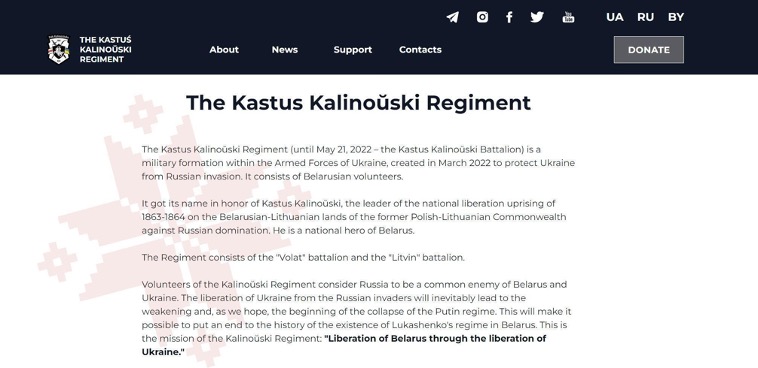
The “About” page for the Kastus Kalinouski Regiment
Since 2020, after mass protests and a crackdown by the regime, much of the Belarusian opposition has been forced into exile. Lithuania and Poland are now the central hubs for these groups, with both countries extending generous visas to anti-regime Belarusians, including the more militant elements. Most of these militants focus their efforts in Ukraine and use Warsaw specifically as a base of operations, relying on the city for logistics, training new recruits, and cooperating with local non-military groups.
Chechens
Chechnya, a Russian republic under the quasi-feudal rule of Putin-ally Ramzan Kadyrov, has also sent fighters to Ukraine. The highest profile Chechen fighters have been the pro-Russian “Kadyrovskii” or Kadyrovites: fighters loyal to Kadyrov. But anti-Russian Chechens, remnants of Chechnya’s independence movement, are also present. Several separate pro-Ukrainian Chechen units appear to be integrated into Ukraine’s Armed Forces, including the Dzhokhar Dudayev battalion, the Islamist Sheikh Mansur group, and the Separate Special Purpose Battalion (OBON) of the Ministry of Defence of the Chechen Republic of Ichkeria. Some reports also refer to a more secretive group that appears to work closely with Ukrainian intelligence.
For pro-Ukrainian Chechens, the conflict is a chance to avenge Russia’s brutal wars in Chechnya and a step in their own independence struggle. Mirroring their Belarusian counterparts, the Chechen volunteers’ motto is ‘After Ukraine, Chechnya.’ For its part, the Ukrainian parliament recognized Chechnya as “under temporary Russian occupation” in 2022, suggesting that Kyiv may support future Chechnyan domestic independence, even if only politically or providing a base of operations.
The 2022 motion highlights that the Ukraine war appears to have granted credibility to other anti-Russian nationalist movements. Since 2022, Kyiv has signaled its interest in supporting anti-colonial movements in Russia beyond Chechnya (or Ichkeria as Chechen nationalists and allies call it). In February 2024, Ukraine’s parliament passed a similar bill recognizing the right to self-determination for Ingushetia, another minority region of the North Caucasus. In July, it proposed a more wide ranging bill calling for greater diplomatic and cultural support for the “national movements of colonial peoples of the Russian Federation.”
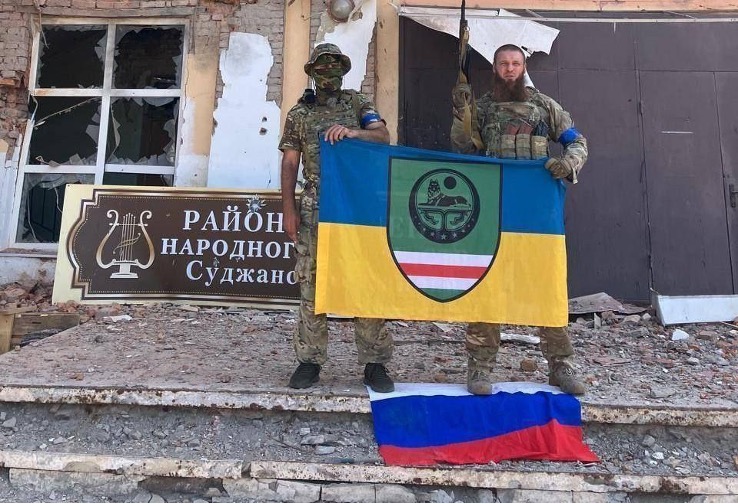
Pro-Ukrainian Chechens Within Russia’s Kursk Oblast. Posted to Telegram, August 2024
Soldiers and Social Media
The number of pro-Ukrainian volunteers from the former Soviet Union are relatively small, totaling a few thousand at most. Tactically, these troops will not change the course of the war. But even relatively small numbers of soldiers can prove useful in commanding the information space. To that end, these volunteers have effectively mobilized social media to drive their ideology and narratives. Kyiv too values these fighters symbolically and politically. It is likely no accident that these units, often coordinating with the Ukrainian military, appear in high-profile battle zones like Kursk and Bakhmut.
The Georgian National Legion of Ukraine has the largest social media presence, with over 266,000 followers on X (formerly Twitter) and a fundraising website. Mamulashvili himself maintains an active online presence on X, with over 75,000 followers. Georgian volunteers have released videos within Russian territory, describing their offensive as payback for the 2008 Russian invasion.
Similarly, the KKR’s 53,000 followers on X are supplied with a steady stream of pro-Ukraine, anti-Russian, and anti-Lukashenko content. The KKR’s YouTube channel has videos with hundreds of thousands of views and one even topping a million. Most videos are simply battlefield footage, but some are ideological. For example, in one video, a spokesman issues a call to arms to the 200,000 – 500,000 Belarusians who have been in exile since 2022 to establish a ‘free and ‘European’ Belarus by defeating Putin in Ukraine and then Lukashenko. The video has over 52,000 views and may have reached a sizable portion of all Belarusians in exile – a relatively small group.
Of the Chechen groups, Dzokhar Dudayev Battalion appears the most reported and active on Telegram. The Sheikh Mansur battalion has over 9,300 followers on Telegram where it has posted photos to show its presence in Kursk. Nationalist leaders, such as Akhmed Zakayev (who formed and leads an anti-Russian Chechen battalion) are coordinating with Ukrainian policy makers, and even appear at public events with Ukrainian elites.
With such a large follower base, volunteers can drive narratives to foster public support and serve ideological purposes. Figureheads such as Mamulashvili and Zakayev can become minor celebrities, granting a sense of credibility and immediacy to their causes. The social media campaigns also use language as a narrative tool. For example, the Telegram, Twitter, and YouTube videos produced by volunteer fighters almost never use Russian, instead relying on English, Ukrainian, and national local languages (some Chechens utilize Russian in some posts, but it is the exception), despite the fact that nearly all Ukrainians, Belarusians, Chechens, and many Georgians are fluent in Russian. The choice to forgo Russian as a lingua-franca is almost certainly intentional, with the use of Russian becoming increasingly controversial among nationalist and liberal circles in Ukraine, Georgia, Belarus, and the former Soviet Union as a whole. A growing number of those in non-Russian former Soviet states increasingly view connections to Russia as a painful reminder of historic Russian domination, the Russian language being an acute example.
Ideologically, Russian nationalist discourses often depict Russia as an exemplar military power and the rightful hegemon within Eurasia. As former Soviet Union members now challenging Russian hegemony, the fighters are contributing to the informational and ideological battlefield by breaking the myth of Russian invincibility. In this context, volunteers from Belarus and the Caucasus can contribute toward legitimizing this viewpoint, giving it real world achievements and immediate goals. Likewise, even if an independent Chechnya seems too far off a goal at present, Chechen volunteers can nonetheless mobilize their presence in Ukraine to further their ideological cause.
A post-colonial anti-Russian ideological stance is not a completely new phenomenon in post-Soviet countries. But the frontlines in Ukraine are now giving an ideal setting in which to push back against Russia in a military sense, but also in terms of imagery and propaganda. In an age of social media, the impact this can have on the informational space should not be underestimated.
Nicholas Castillo is an international affairs researcher focussing on East Europe and Eurasia, conflict studies, and the politics of identity. He is a program officer at the Caspian Policy Center.
 Charged Affairs