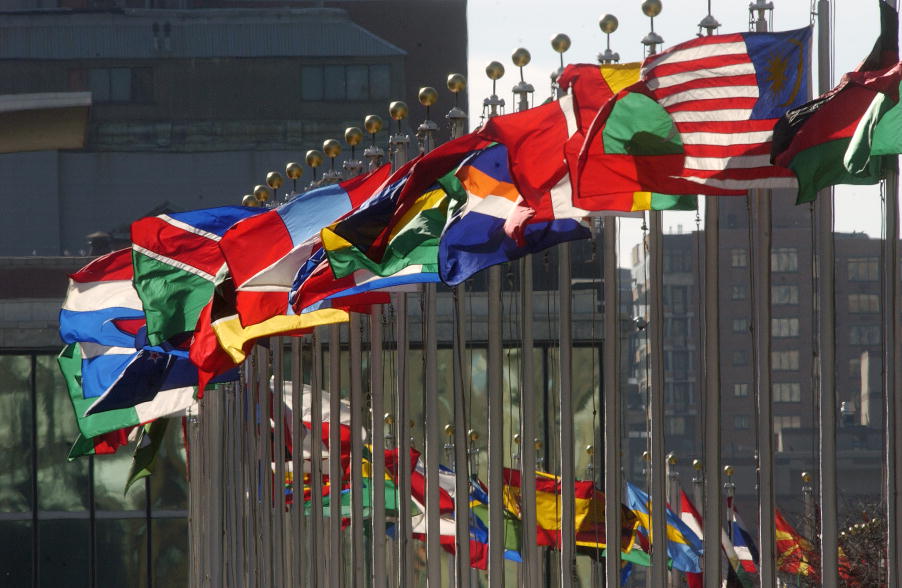
Lam Tran | Rising Experts Assistant Managing Editor | May 15, 2025 | Photo Credit: Flickr
Sweating in my blazer, I rehearsed my 30‑second pitch at a networking event organized by my graduate program in Washington, D.C. Tables of ambassadors, lobbyists, and financiers ringed the room; anxious grad students rotated after every seven minutes. When the whistle shrieked, I thanked a former U.S. ambassador for her time, picked up my notebook, and hurried to the next table.
There, a senior commodity trader gave me a firm handshake and skipped the pleasantries. “Post-Cold War institutions are crumbling. Don’t look to New York, London, or D.C.—look to Houston.” Energy, advanced manufacturing, and climate tech, he explained, will drive the next chapter.
Walking home, his words looped in my mind. Look to Houston, not New York or D.C. The career path most International Relations (IR) students had been pursuing—straight through Foggy Bottom and the U.N. plaza—suddenly felt like it might end in mid‑air. Strangely, the trader’s suggestion also felt like validation of a latent anxiety that finally materialized into hard reality. As the liberal world order as we know is under backlash, and institutions embodying it are defunct, I found myself wondering: Should we keep clinging to the listing vessel of the old order, hoping to patch its hull, or build a new boat?
Dreams and Disillusionment
A day after this networking event, I received the official notice that my summer internship with the State Department was deferred. It wasn’t an isolated glitch. My classmates and friends are getting laid off from USAID, having offers rescinded at intelligence agencies, and seeing firms they wanted to join after graduation shut down their operations. The international development industry, where the majority of my cohort hopes to join upon graduation, appears to be disappearing after one night.
This is the backdrop against which my classmates and I are planning our futures. Emotionally, it’s a rollercoaster. Many of us feel a calling to public service – to work on climate change, poverty alleviation, conflict resolution– not for financial gains but because of a commitment to build a more just and equitable world. Yet, we’re confronting the reality that the existing avenues for that work are narrowing.
Anxiety also seeps into other aspects of life, not just the internship hunt. Professors talk about grants frozen mid‑stream; classmates worry about having a visa revoked without proper explanation; group chats quietly migrate to encrypted apps because a stray opinion might torpedo a clearance. The sense of helplessness is prevalent; years spent mastering languages, publishing papers, and winning fellowships could be nullified by a new political force. In a capital whose choices ripple across the globe, it seems as though those at the helm have turned away from the very people who keep the machine running.
The Crumbling International Order
IR professionals chose this field, believing in the global institutions’ role to solve global challenges. Crises after crises, however, have laid bare their limits. The U.N. Security Council, paralyzed by veto politics, fails to effectively address Syria’s carnage or Russia’s assault on Ukraine. The World Health Organization, meant to unite nations in pandemics, became a partisan piñata when Washington twice withdrew its membership mid‑COVID. The World Bank and International Monetary Fund, once pillars of development, face charges of lost credibility from scholars and Global South peers who say decades of conditional loans did more harm than good.
Public trust mirrors this erosion. Only one‑fifth of Americans trust their federal government, and only one-third approve of the job of multilateral organizations. Warnings that the post-Cold War liberal international order is unraveling grew loud under the first Trump administration. A few months into the second Trump administration, the political environment is even more hostile, and for young professionals here, the future of the issues we care about—climate, health, human rights—looks dimmer than ever.
A Generation at a Crossroads
A tension underlies all these developments: Do we pour our energy into saving and reforming the old institutions, or do we channel it into building new ones? This isn’t an abstract question but one that would determine where to apply for jobs, what projects to support, and what vision of the future to commit to.
On one hand, there’s a strong argument for not giving up on the institutions. They may be flawed, but they have resources, legitimacy, and a foundation we can work with. Bodies like the U.N., WHO, and the World Bank still do crucial work: feeding refugees, coordinating disease response, and delivering essential aid in war zones. Abandoning them wholesale could mean abandoning millions of vulnerable people who rely on their programs. Moreover, serious reform proposals such as UN Security Council enlargement are on the table, and the World Bank’s climate‑finance overhauls are underway.
On the other hand, the case for starting anew grows stronger each day. It’s not lost on us that some emerging powers and groups are already building parallel structures. The past decade saw the creation of the Asian Infrastructure Investment Bank (AIIB) led by China and the New Development Bank led by BRICS countries, providing an alternative to the World Bank. Regional blocs and mini-lateral groups, including the Quad, ASEAN, or the African Union, are tackling maritime or cyber norms while the formal architecture stalls.
“Looking to Houston”
The notion of “looking to Houston” has evolved for me. I may never physically move to Houston, but I interpret it as advice to hold tight to my moral ambitions and seek opportunities in unexpected places. Maybe it means focusing on the renewal of advanced manufacturing capability domestically as a foundation for effective foreign policy, as the former National Security Advisor Jake Sullivan called “foreign policy for the middle class.” Maybe it means engaging with the private sector, where much of today’s innovation happens, and steering it toward the public good. Maybe it means aligning with cities, states, or international networks that operate outside old treaties.
For my peers and me, this moment feels overwhelming and personal. But ideals—peace, equity, a livable planet—outlast the scaffolding built to serve them. If the old order is a listing vessel, we can salvage what we can, forge what we must, and keep moving toward shared goals—whether the map says New York, D.C., or, unexpectedly, Houston. The venue changed, not the mission.
Lam Tran is a graduate student at Georgetown University studying Science, Technology, and International Affairs and an Assistant Managing Editor with the YPFP Rising Experts Program.
 Charged Affairs