Thomas Maddock| Rising Expert on European Affairs | June 11, 2025 | Photo Credit: Flickr
While the UK-EU summit made progress in reinforcing NATO’s European pillar, the forthcoming NATO summit will define the future of European security.
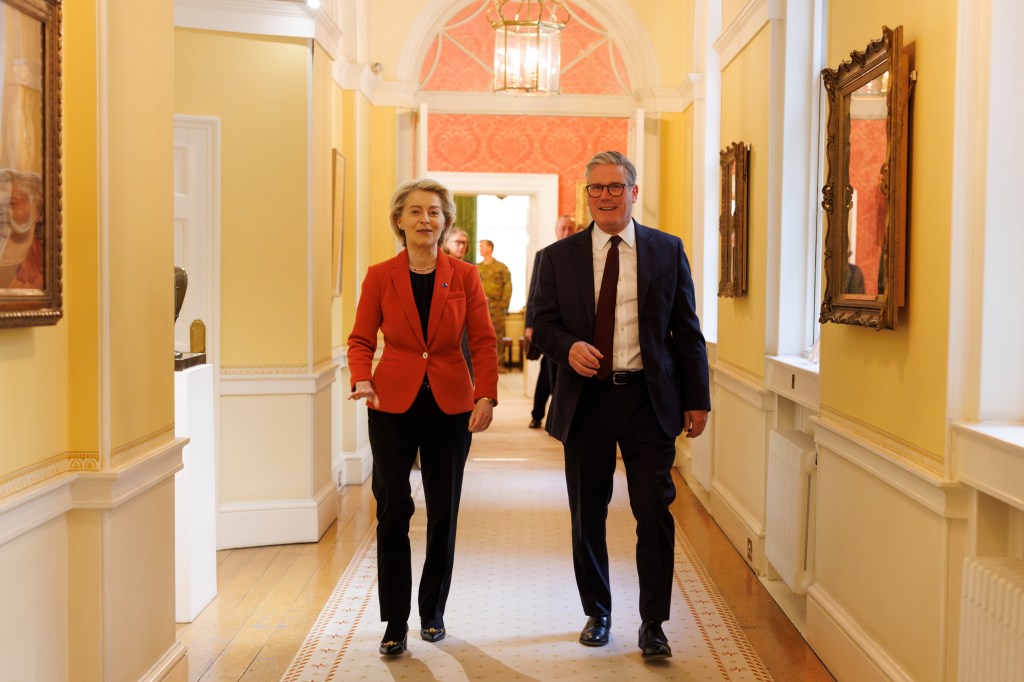
Unsettled by US President Donald Trump’s trade war and threats to withdraw from NATO, Europeans are now asking themselves where they might find a friendly hearing in the second Trump administration. In this context, Europe is holding two key summits: the UK-EU Summit, held on May 19 in London, and the NATO Summit, to be held June 24-25 in the Hague. The London Summit, which brought together UK PM Keir Starmer, European Commission President Ursula von der Leyen, and European Council President António Costa, advanced various facets of the EU-UK relationship. It committed to further discussions on establishing a common sanitary and phytosanitary area, facilitating the flow of animal and plant goods between the UK and the EU. Existing fisheries arrangements, a long-standing area of contention, were rolled over until 2038, settling the issue for the foreseeable future. The EU and UK agreed to link their emissions trading schemes and re-integrate the electricity markets. Even discussions for a youth mobility scheme, domestically popular but opposed by the UK Government, were backed.
The Summit showed the strengths and limitations of Europeans’ response to security threats of a potential US withdrawal and an aggressive Russia. For strengths, both sides backed a Security and Defence Pact, paving the way to future cooperation. The Summit established regularised dialogues between high-level UK and EU officials, including a sixth-monthly dialogue between the UK Foreign and Defence Secretaries and the EU’s chief diplomat and an annual Security and Defence Dialogue. These dialogues will fill an information gap in UK-EU defence cooperation. However, the Summit did not fully resolve a key challenge in the building of a European defence industrial base. While the Strategic Defence Partnership now creates the conditions for the UK to participate in the EU’s SAFE loans facility, a €150 billion ($170 billion) loan programme to fund EU rearmament, the precise terms, including financial contributions, still need to be negotiated, as expected for any non-EU country. Although both sides are committed to “swiftly explore” such a possibility, full UK participation remains subject to further agreement. Even if these hurdles are overcome, such programmes remain so far untested. While the Summit laid groundwork for future progress, there still remain questions about the EU’s capacity in defence ambitions and how the UK can contribute to this.
Challenges to Strengthening the European Pillar
Strengthening the UK-EU security partnership is essential to mitigating the threats of Trump 2.0. Yet, despite the progress made so far, three key challenges remain in developing this partnership. The first concerns Britain’s own political will in strengthening cross-Channel ties. Though the incumbent Labour Government seeks to engage its EU counterparts more constructively than some of its predecessors, its ambition for a deeper EU-UK partnership remains constrained. The Labour Government’s policymaking remains driven by fears of how Reform UK, a hard-Right political party, might take seats from Labour in the next election, due by 2029. A More in Common poll in April 2025 found Labour would currently lose 153 seats to Reform. Despite a strong public consensus in favour of a UK-EU Security Pact (a BFPG survey recorded 69% in favour of one), the Government wants to avoid a backlash from Leave voters for appearing to reverse Brexit. Given the threat posed by Reform, some fear that even the modest progress made in the UK-EU Summit may mark the peak of the so-called UK-EU “reset” sought by the Government.
Second, progress in the bilateral partnership remains constrained by the linkages of other political issues. Progress towards a UK-EU Security Pact was reportedly linked to progress on fisheries talks. For an industry that represented just 0.04% gross value added to the UK economy in 2024, its prominence reflects an emphasis on symbolic political issues over pressing security needs. By the same token, the decision to roll over existing provisions until 2038 is positive for preventing this issue from recurrently obstructing defence cooperation.
The third, and perhaps the most significant, barrier to a stronger UK-EU security partnership comes from the United States. Europeans need to shore up their security to mitigate a potential United States withdrawal, without precipitating the withdrawal of US troops in the process. Generally, the European solution has been increasing national defence spending, attempting to address Trump’s criticism that Europeans skimp on it. This solution is both a response to the military threat posed by Russia and a political signal to Washington that Europe is accepting its demands for Europeans to spend more on defence.
Yet even this approach carries risks. There is no guarantee that increasing European defence spending will appease the demands of the Trump administration or guarantee continued US engagement. The criticisms of Trump and his closest followers extend beyond just defence spending to issues of trade, the regulation of big tech firms, the suppression of far-right political parties, and to the very foundations of the EU project. Raising defence spending is only a partial response to a genuine concern that Trump and his advisers have toward Europe. Though the UK does not attract the same level of criticism as its European counterparts from the Trump administration, risks remain for Britain. Splits with the United States over Ukrainian, Greenlandic, and Canadian territorial integrity could degrade the British position. Furthermore, should the Americans see UK-EU rapprochement as European security independence from Washington, it may accelerate the very rupture it aims to prevent. Europeans should communicate clearly to the President that this rapprochement is not at the expense of trans-Atlantic ties, but complementary to them.
Future Trajectories of the Trans-Atlantic Alliance
NATO’s June Summit in the Hague will surface answers to many European questions. As the first leaders’ meeting since Trump’s return, three key questions will showcase how Trump views the alliance’s future. First, there is the question of whether Ukrainian President Volodymyr Zelenskyy (or indeed another Ukrainian official) will be invited to attend. Zelenskyy’s previous attendance at NATO summits since Russia’s full-scale invasion provided a signal of the alliance’s unity behind supporting Ukraine; with the United States reportedly resisting an invitation to Zelenskyy, his absence would reflect a prioritisation of Trump’s views over signals of solidarity with Ukraine.
Second, there is the question of money. Since his first presidency, Trump has consistently criticised his European counterparts for missing NATO’s target for each country spending at least 2% of GDP on defence and has demanded NATO allies meet a new 5% target. The daunting fiscal picture of European NATO states means a 5% target is unfeasible in the near term for several of them. Yet a raised spending target is still to be expected, if only to avoid friction with the United States.
The third question centres on the conduct of the US President. While a dramatic outburst—such as the infamous Oval Office meeting involving Trump, Zelenskyy, and Vice President JD Vance—seems less likely at a NATO summit with more than 30 allied leaders present, tensions may nonetheless escalate. A contentious conclusion remains plausible, with disagreements spanning issues from Greenland to Ukraine. To better anticipate Trump’s potential reaction, European leaders might monitor his response to the EU-UK Summit and his broader attitude toward European initiatives to bolster their own defence.
The views expressed herein are solely those of the author and do not represent those of any institution or organization.
Thomas Maddock is the 2025 Rising Expert on European Affairs. He holds a master’s degree in European Affairs from Sciences Po.

 Charged Affairs