By Alexandria Virginski | YPFP Member | July 9, 2025 | Photo Credit: Florent Vergnes, Agence France-Presse
Wagner at Its Peak
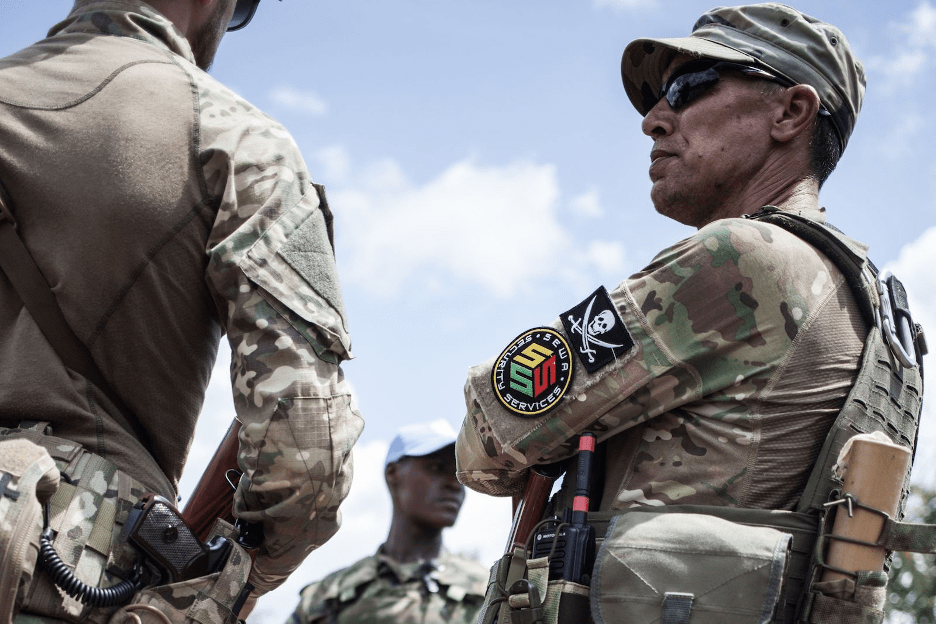
The Wagner Group (Вагнер “Wagner”), officially known as PMC Wagner, is a Russian-backed private military and security company (PMSC). The PMSC first attracted media attention for its involvement in the annexation of Crimea back in 2014, operating alongside Russian army units. In the decade following its creation, the Wagner Group significantly expanded its security operations into at least a dozen countries, primarily in Africa, up until the passing of its leaders—Dmitry Utkin and Yevgeny Prigozhin—in a plane crash in August of 2023 following their failed mutiny against the Kremlin. Despite an agreement brokered by Belarusian President Alexander Lukashenko to relocate Wagner personnel to Belarus, the organization was significantly weakened by a leadership vacuum and a fragmented cross-border operational structure. Over time, many former Wagner personnel left Belarus, opting for civilian life, or joined some of the next big players in the industry like Africa Corps and Redut.
Africa Corps (Африканский корпус “Afrikanskii korpuss”) Builds on Wagner’s Progress in the Sahel Region
On the one-year anniversary of the failed mutiny, BBC Russia reported that Yevgeny Prigozhin’s son, Pavel Prigozhin, had assumed authority over Wagner. Nevertheless, the mutiny left the organization stranded, and the Russian Defense Ministry, along with The Federal Service of Troops of National Guard of the Russian Federation (Росгвардия “Rosgvardiya”), filled the power vacuum by assuming control over many of Wagner’s African operations. The result was a re-branding and centralizing of Russia’s presence in the region under the name “Africa Corps,” also referred to as the Russian Expeditionary Corps (REK).
Despite the illegality of PMSCs under Article 13.5 of the Russian Constitution, Africa Corps has played a central role in advancing the Kremlin’s geopolitical objectives by functioning as a covert instrument of soft power for the Russian Defense Ministry. Notable developments include Russia’s growing relationship with the Alliance of Sahel States—comprising Burkina Faso, Mali, and Niger. These regimes have been seeking protection not only from jihadist insurgents—such as, Jama’at Nusrat al-Islam wal Muslimeen (JNIM), Islamic State in the Greater Sahara (ISGS), and Islamic State in the West African Province (ISWAP)—but also from the perceived threat of Western ideology and fear of neocolonialist policies. Russia has positioned Africa Corps as the solution to these troubles.
Other regimes, including the Central African Republic (CAR), Libya, and Sudan, have similarly come to view Russia as an ally capable of facilitating military training and combat assistance that other states have either been unwilling or unable to provide in the evolving international climate. In reality, the results have been mixed. On one hand, Africa Corps has protected state sovereignty. However, on the other hand, this has come at the cost of human rights, as allegations implicate Africa Corps in mass murders, sexual abuse, and other atrocities against civilians—not to mention the industrial-scale smuggling of natural resources such as gold, diamonds, and timber, which the group has purportedly used to fund the war in Ukraine.
What this behavior clearly demonstrates is Russia’s renowned commitment to Africa Corps as a vehicle for securing tactical and economic advantages. This has expanded Russia’s logistical reach, with ports like Conakry, Guinea and airbases in Bamako, Mali being used for shipments of tanks, armored vehicles, artillery, radar-jamming units, and even Su-24 fighter-bombers. Resource-for-security deals with lucrative mining agreements has also financed Russian operations abroad, all while embedding soft power influence in national power structures.
Redut (Редут “Redut”) Plays a Decisive Role in the War with Ukraine
Another PMSC that has gained popularity in recent years is Redut. Initially a competitor to Wagner, Redut was involved in very high-level plans in the first days of the invasion, including an alleged scheme to kill the President of Ukraine, Volodymyr Zelenskyy. However, its operations were largely unsuccessful, especially in comparison to those of Wagner—so much so that after sustaining significant losses in Ukraine, Redut folded into the Russian Ministry of Defense to avoid perishing altogether. Since then, the group has absorbed the remnants of Wagner in an effort to rebuild and rebrand itself.Unsurprisingly, the group has been largely successful, due in part, to funding by the Russian Military Intelligence Agency (Главное разведывательное управление “Glavnoe Razvedyvatel’noe Upravlenie”) (GRU).
Unlike Africa Corps, which is largely motivated by economic gain through resource extraction and the consolidation of influence over valuable minerals and state contracts in Africa, Redut focuses more on political and intelligence-driven operations, aimed at supporting Russian foreign policy objectives, such as gathering sensitive information and maintaining influence in areas closer to Russia’s traditional sphere of interest. Redut’s ties to the GRU suggest that intelligence gathering and internal regime stabilization—rather than profit—are at the core of its activities. In this way, Redut serves not only as a proxy military tool, but as an extension of Russia’s intelligence and political influence operations.
The Beginning of a New Era
Since the rise of Wagner, an expanding Russian military-business complex has emerged, increasingly blurring the lines between state and corporate entities. Russia has leveraged PMSCs as tools for projecting political and economic influence abroad, marking a new era in which these ostensibly independent private actors function as proxies for the regime. The dissolution of Wagner does not signal a retreat from this model; rather, it opens the door for a new generation of PMSCs that are more tightly controlled by the Russian state. Emerging entities like Africa Corps and Redut will likely continue fragmenting into smaller units under the oversight of the Ministry of Defense to avoid the autonomy and political risks associated with Wagner. Closely tied to state-aligned corporations such as Gazprom and Rosneft, these groups will focus on securing Russian interests abroad—particularly in resource-rich regions of Africa, Latin America, and Central Asia. Additionally, they are expected to adopt more legitimate corporate branding and integrate advanced surveillance and cyber capabilities, making them more versatile instruments in Russia’s hybrid warfare. In essence, Russia is not abandoning the PMSC model, but refining and repurposing it into a more disciplined and deniable extension of state power.
Alexandria Virginski is an immigration attorney, specializing in employment-based visas. She earned her Juris Doctor from the University of Wisconsin with a concentration in international and comparative law, and holds dual Bachelor of Arts degrees in international relations and Spanish from Michigan State University.

 Charged Affairs