By Thomas Maddock | Rising Expert on European Affairs | September 5, 2025 | Photo Credit: Flickr
The views expressed herein are solely those of the author and do not represent those of any institution or organization.
Europeans’ reaction to the European Union’s (EU) trade deal with the United States (US) ranged from resigned acceptance to outright opposition. Agreed on 27 July 2025 in Scotland, the US-EU trade deal set a 15% tariff rate on most EU exports to the US, down from the initial 30% floated by President Trump (though up from the baseline rate of around 1.47% before Trump took office). In return, the EU committed to spending €700 billion ($750 billion) in US energy imports over three years. The EU also pledged to invest €550 billion ($600 billion) in the US, mostly through private investment. Many of these provisions are subject to further negotiations, but given that trade powers lie with the EU rather than national governments, this deal effectively sets the scope for the future of US-EU trade relations.
Though the EU avoided a worst-case scenario, criticism surfaced quickly after the deal was announced. French Prime Minister, François Bayrou, tweeted that the European Commission who reached the deal had “resolved to submission”. Even those welcoming the deal were reluctant: Spanish PM Pedro Sánchez said he backed the deal “without any enthusiasm”, German Finance Minister Lars Klingbeil called the deal “weak”, though the German government supported it. The deal prevented an escalatory trade war between the EU and the US, but on paper and in practice, it would carry damaging consequences for the EU and for the global economy.
Criticisms of the deal
While recognising the difficult circumstances in which the European Commission struck the deal with the Trump administration, critics have identified several key issues with the deal, three of which stand out.
First, despite having deplored “unjustified” US steel tariffs in March 2025, the 50% tariff rate on EU steel exports will remain in place. Eleven EU member states, including France, backed a proposal calling on the Commission to introduce measures to secure the EU steel industry. Negotiations on this issue will continue.
Second, the expanded US energy imports were similarly contentious. Expanding gas and oil imports clashes with the bloc’s climate ambitions and, critics argue, creates a new dependency on the US. In this view, the EU is shifting from its dependency on Russian gas and oil to depending on US energy imports. Indeed, the Commission even described the expanded EU imports of US gas and oil as a means to reduce reliance on Russian supplies. However, creating a new dependency on US energy conflicts with Europe’s professed goal of boosting strategic autonomy.
Third, the feasibility of the €550 billion ($600 billion) in EU investments in the US has been questioned. The Commission admitted that it could not direct those funds itself, as these funds would come from private investment, not public money. In the future, this could become an area of contention in US-EU relations. If private investments fail to materialise, Washington might accuse Europeans of failing to meet their commitments.
What else could the EU have done?
Critics of the deal argue that the EU, as the world’s largest trading bloc, should have instead sought to counter the US president rather than settle for a flawed deal. This argument is not without merit; the EU has recently armed itself with the Anti-Coercion Instrument (ACI), a powerful tool for deterring exactly this kind of coercive measures from third countries. Though initially conceived as a response to Chinese economic coercion against Lithuania, the instrument is country-agnostic (i.e. it is not limited to any single country), meaning in theory that the EU could deploy countermeasures against the US. The ACI is often referred to as the “nuclear option”, with sweeping powers available to the EU, including restrictions on goods and services trade. It has not been deployed since it entered into force in December 2023, yet its countermeasures could well tip the balance in any trade war.
Restrictions on services trade are particularly important. Whereas the EU runs a trade surplus in goods with the US – i.e. it exports more goods to the US than it imports – the inverse is true for trade in services – the EU imports more than it exports to the US. Just as the EU is vulnerable to Trump’s tariffs on EU goods, the US would be vulnerable to any EU countermeasures on services trade. The logic holds that either the use or the threat of the ACI could have forced the Trump administration to a better deal. Yet for all that the nuclear option is indeed powerful, the ACI does have limitations. For a deterrence tool to work, credibility is required. Target countries need to believe that the EU will credibly deploy this tool against it. In the case of the ACI, the EU has a credibility gap.
How to understand the EU’s approach
Why then did the EU pursue the deal rather than deploy the ACI? After all, the punitive measures set forth by President Trump seem almost a textbook case of economic coercion. A few explanations stand out.
First, it is not certain that countermeasures or threats to deploy them, would have deterred the Trump administration. Indeed, as with the examples of China and Canada, a more confrontational approach might have yielded escalation rather than a climbdown. In contrast, the UK government has sought to accommodate the US president, and received a lower baseline tariff rate of 10%. Japan, during Abe Shinzo’s premiership, became the gold standard in managing Trump during his first term, pioneering the strategy of flattery with gifted golden golf clubs. Given the overall gloominess of Europe’s current economic prospects, risking transatlantic trade Armageddon seemed more daunting than a flawed deal.
The deterioration of the EU’s relations with China will also have factored in. Despite initial expectations that the EU, facing Trump’s tariffs, might seek to mend fences with China, EU-China trade tensions have instead worsened over 2025. The EU remains opposed to Chinese goods being dumped on EU markets, particularly as Trump’s tariffs on Chinese goods push Beijing to sell elsewhere. China’s dominance in key supply chains, particularly in renewable energy techs and some critical minerals, create profound vulnerabilities for the EU economy.
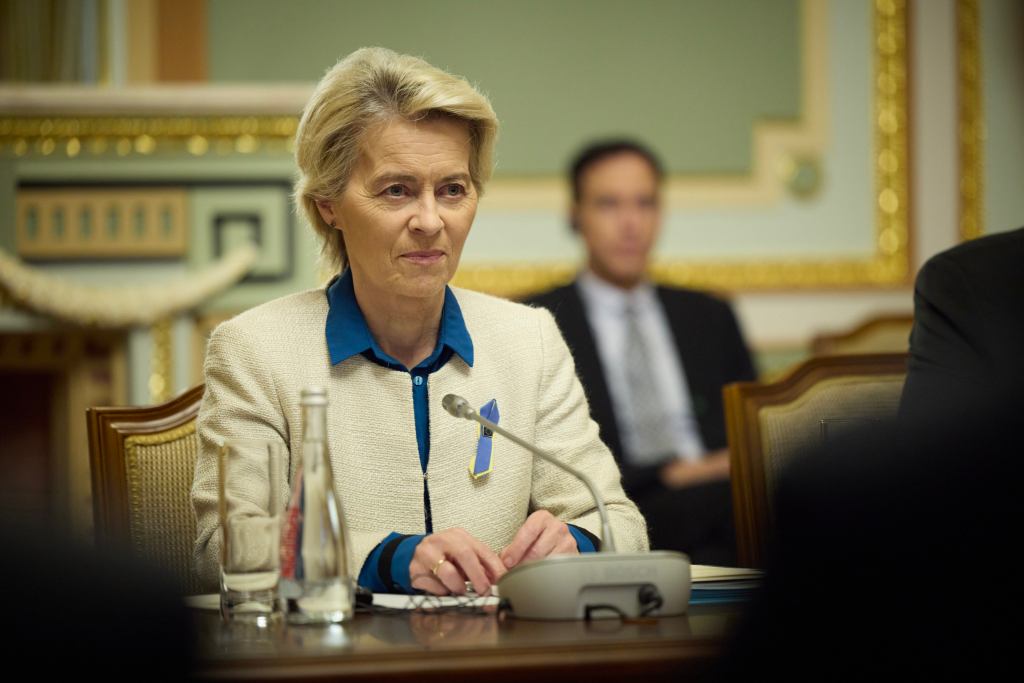
The recent EU-China summit marked 50 years of EU-China relations but also encapsulated the dramatic deterioration in relations. A meeting between European Commission President Ursula von der Leyen, European Council President António Costa, and Chinese President Xi Jinping provided no real answers to EU concerns. President von der Leyen described EU-China trade relations as at an “inflection point.” Facing economic threats from both China and the US, the EU seems to have concluded that Washington remains the more biddable threat.
The EU’s refusal to deploy its nuclear option also reflects that security questions are overriding economic ones. Russia, not the US, is Europe’s main security threat; the US remains Europe’s main security guarantor. Over the past couple of months, the US president has adopted a mixed approach to Moscow, with some explicit criticism of his Russian counterpart (though these gestures should not be overstated in their impact). Following comments from former Russian President Dmitry Medvedev, the US deployed nuclear submarines near Russia. NATO countries and the US have been exploring a new scheme to get weapons to Ukraine, whereby Europeans will buy US equipment to donate to Ukraine. Although this scheme is less supportive than under the Biden administration, and with its efficacy still uncertain, it marks a shift from the earlier acrimony between President Trump and President Volodymyr Zelenskyy. Zelenskyy’s meeting on August 18 with Trump, flanked by seven of his EU and European allies, demonstrated both the improvement of personal relations between the two and the role of European leaders in driving this warming of ties.
In this context, a trade spat with Washington could derail US support for countering Europe’s main security threat, Vladimir Putin’s war machine. This point was made explicit by President Costa, who said that the EU’s acceptance of the trade deal with the US was driven by threats from Moscow and the need to keep the US on side. These security factors extend beyond Ukraine, however. President Trump’s overtures to take Greenland, an autonomous territory of EU member state Denmark, create an additional security incentive for the EU to keep in Trump’s good graces.
Where does the EU go from here?
The future of the deal remains uncertain. For the deal to enter force, it will require adoption by the European Parliament and European Council, both of which include groups opposing the deal. In the European Parliament, the second-largest bloc, the centre-Left Socialists and Democrats group have announced their opposition to the deal. This means for the deal to pass in the Parliament, the centre-Right European People’s Party will need to secure votes elsewhere, perhaps from the hard-Right groups. In the Council, the EU body representing member state governments, there is similar resistance to the deal, as previously mentioned. Indeed, the German government, which broadly supports the deal, has signalled that US tariffs on European cars would need to be reduced before any agreement could enter force.
Beyond the deal, future spills with the Trump administration feel almost inevitable. The tensions in the transatlantic alliance cut across too many issues for any deal to completely settle disputes. The Trump administration’s issues with the EU run deeper than trade deficits: it is ideologically opposed to the EU as a multi-state project. EU efforts to regulate digital spaces will particularly hit US tech giants, another source of tension with Washington. High profile members of the Trump administration, including Vice President JD Vance and Defense Secretary Pete Hegseth, have expressed deep reservations about Europe, particularly on perceived limits on free speech. This raises a concern that the breach in the transatlantic alliance will outlast Trump’s second presidency.
The question, therefore, is how the EU should contend with an erstwhile ally that is becoming increasingly confrontational. The biggest risk from the US-EU trade deal is not just that it worsens the transatlantic trade paradigm, nor even that it creates potential areas of dispute between Washington and Brussels, especially around EU investment levels in the US and energy imports. Its biggest risk is that it shows when the US applies coercive measures against the EU, Brussels will eschew trade defence tools and settle for a worse trading arrangement. This begs the question: Were Washington to renege on the US-EU trade deal and target the EU once more with higher tariffs, how would Brussels respond? This episode suggests that the EU would probably accept a worse arrangement rather than risk a breach in ties. In this regard, the ACI has become the nuclear option not just because it would risk severing transatlantic ties and a form of economic mutually assured destruction. It is now the nuclear option because Brussels appears unwilling ever to drop the bomb.
Thomas Maddock is the 2025 Rising Expert on European Affairs. He holds a master’s degree in European Affairs from Sciences Po.

 Charged Affairs