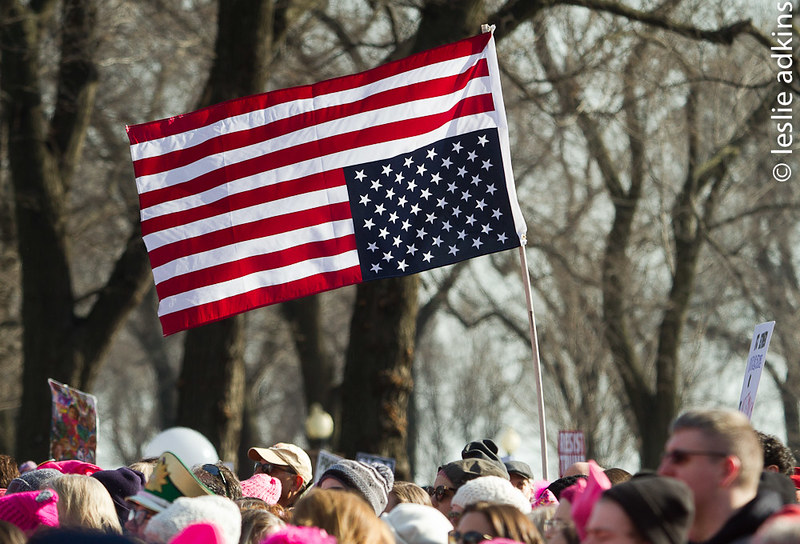
By L.M. Schmidt | Rising Expert on Gender | November 21, 2025 | Photo Credit: Flickr
In June 2025, Democratic Minnesota state legislators, Melissa and Mark Hortman, were shot dead, along with their dog. Two other Democratic officials were critically wounded. The gunman carried a kill list of over 70 progressive figures, and he was “called by God” to act.
A few weeks later, in an already battered Minnesota, yet more murders: a shooter fired on praying students through the windows of a church on August 27th, killing two children and wounding eighteen others. The shooter, now dead, left behind hundreds of pages of unhinged antisemitic manifestos, expressing hate toward “almost every group imaginable”, including Black, Mexican, and Jewish persons.
And now: silence. Outside of local coverage and online activist networks, there has been remarkably little national attention. Nationally, the response was minimal. No wall-to-wall coverage. No emergency debates. For most of the country, these stories of violence now disappear within days.
This silence is not accidental. Far-right violence is being absorbed into the political mainstream and folded into a deliberate MAGA GOP strategy. Each so-called “lone wolf” stochastic attack serves a key political function for Trump’s version of nascent American authoritarianism, by intimidating opponents and flooding the news cycle with purposeful chaos, leaving Democrats and the public too disoriented to respond.
Two patterns are clear: first, these attacks are not aberrations. They are the predictable result of MAGA rhetoric that primes individuals for violence and institutions that normalize it. Second, Republicans are weaponizing the churn of the media cycle itself, ensuring that tragedy is quickly buried under the next crisis, reinforcing mistrust in democracy while their opponents remain permanently on the defensive against the next so-called “lone wolf” attack.
This should not be a surprise. Media disruption was explicitly outlined as a goal in Project 2025 before the 2024 elections. Its Mandate for Leadership: The Conservative Project devotes 65 pages to the importance of directing media narratives. This is stochastic terrorism: public figures use incendiary language that increases the likelihood of violence without directly ordering it. And while the violence itself is deplorable, the real aim is to shape public perception. Democrats, however, continue to appear unprepared, with no counter-strategy to blunt this narrative strategy.
To dismiss these cases as simply “lone wolf” incidents or part and parcel of America’s gun violence epidemic is a mistake. Instead, they reflect a broader tactic: current American violence is not only committed but mediated. Each attack is briefly spotlighted, the link to the far-right’s current discourse on conspiracy theories, xenophobia, and violence is made clear; then the case is buried under fresh chaos, a deliberate part of the GOP’s media strategy to overwhelm the news cycle, anesthetize the populace to repeated violence, and deflect accountability. Even the violent tactics, cruelty, and show of force exhibited by ICE are demonstrative of this strategy.
The list of attacks is long. In 2018, 11 people were murdered at Pittsburgh’s Tree of Life synagogue by a far-right assailant. In 2019, a gunman killed 23 Latino shoppers at a Walmart in El Paso, citing Trump’s “invasion” rhetoric. In 2020, a man armed with homemade weapons was arrested outside New Mexico’s Secretary of State’s office. In 2022, five people were murdered at Club Q in Colorado Springs, and 10 Black shoppers were killed in Buffalo by a self-described “ethno-nationalist.”
The incidents continue today. On July 8, a 68-year-old self-identified MAGA supporter was arrested for firing at a Hispanic family while shouting racial slurs. Days later, a 33-year-old man was convicted of beheading his father, leaving behind a manifesto invoking Trump and plans for further attacks on federal officials.
Communities are denied time to mourn or mobilize, while the fear lingers. Kill, amplify, move on: a cycle that ensures more violence and an increasingly numb civilian populace.
Ex-FBI Director Christopher Wray has repeatedly stated that far-right lone actors represent the greatest domestic terror threat. Yet we continue to treat these cases as isolated.
With deeper analysis, it’s clear that the so-called lone wolf carries the pack’s logic: each act inspires the next, and media coverage that frames them as aberrations only guarantees repetition. The same week as the Minnesota assassinations, Donald Trump called for the execution of Governor Tim Walz after Walz labeled the attack “targeted political violence.” Trump’s words — “traitors get death” — drew cheers from his MAGA audience. Simultaneously, Utah Senator Mike Lee quipped about the Minnesota shootings being a result of “Marxism” on his personal X account, to the applause of his right-wing online audience. Tina Smith, a junior Minnesota senator, confronted Lee in Congress, telling him his comments were “brutal and cruel.” Lee only removed his X posts after widespread criticism.
Violence in response to political differences is no longer fringe. Trump’s rhetoric, “ruthless, inflammatory and designed for maximum viral reach,” as The New York Times describes, has directly escalated civilian violence. At the June “No Kings” protests, an innocent bystander was shot and killed in Utah by self-identified “peacekeepers.” Armed men threatened demonstrators in Arizona, Tennessee, and California. Vehicles were driven into protestors in Virginia and California. These are not isolated incidents; they show how quickly far-right rhetoric is turning public space into a battleground.
Trump now commands the military, federal police, and the aforementioned more-militarized ICE. But a more insidious threat comes from radicalized civilians, overwhelmingly white men emboldened by online extremism and MAGA political leaders, and enabled through the ICE’s wildly inconsistent use of warrants and random ID checks that have enabled multiple extrajudicial kidnappings; and the Trump administration’s now-common cancellation of security details for political opponents. These so-called “lone” actors function as an irregular force: not formally directed by the GOP, but strategically useful to it. The party cultivates the rhetoric that drives them while maintaining plausible deniability, insisting these attacks are spontaneous rather than the predictable result of its own incitement.
The same logic is visible in the culture wars. The revocation of swimmer Lia Thomas’s collegiate titles was not just a sports ruling but a signal that non-political institutions are moving in alignment with MAGA priorities. When people are framed as existential threats, discrimination becomes policy, and violence shifts from exceptional to expected.
And once again, the media absorbs these flashpoints as “debates” rather than coordinated intimidation. Outrage burns quickly, then pivots elsewhere, leaving targeted communities under threat while the national conversation moves on. The violence lingers; the coverage evaporates, by design.
Even Republicans acknowledge the danger. As The New Republic reported, GOP lawmakers are “scared shitless” not simply of Trump but of the “personal vindictiveness and constant threat of political violence from his MAGA base.”
This constant violence is not chaos; it’s policy operating by design. A frightened populace numbed by constant random violence is easier to govern.
Recognizing these stochastic terrorist attacks as part of an authoritarian strategy is essential. If we treat them as random, we keep waiting for a tipping point that will never come. But if we see them for what they are — deliberate manipulation of public panic —we understand the tipping point is already here. Breaking that cycle, while protest, dissent, and free elections remain possible, is the only path to preventing democratic collapse.
Leah Madelaine Schmidt is a research fellow for the North American and Arctic Defence and Security Network and co-Editor-in-Chief of The Cambridge Review of International Affairs. She is a 2025 Pierre Elliott Trudeau Foundation scholar and a Ph.D student in Gender Studies at the University of Cambridge Department of Politics and International Studies, focusing on critical security studies.

 Charged Affairs