By Marialaura De Angelis | Rising Expert on Multilateralism and Diplomacy | February 4, 2026 | Photo Credit: Flickr
Vietnam has often been cited as a potential model for North Korean economic development, contingent on denuclearization and a transformed security environment that would enable Pyongyang to pursue reforms similar to Vietnam’s Đổi Mới. Through this policy, Vietnam was able to achieve rapid economic growth, significant poverty reduction, and integration into the global economy, all while maintaining Communist Party rule – which made it the most credible path forward for the Kim regime once hostilities on the Peninsula had ended.
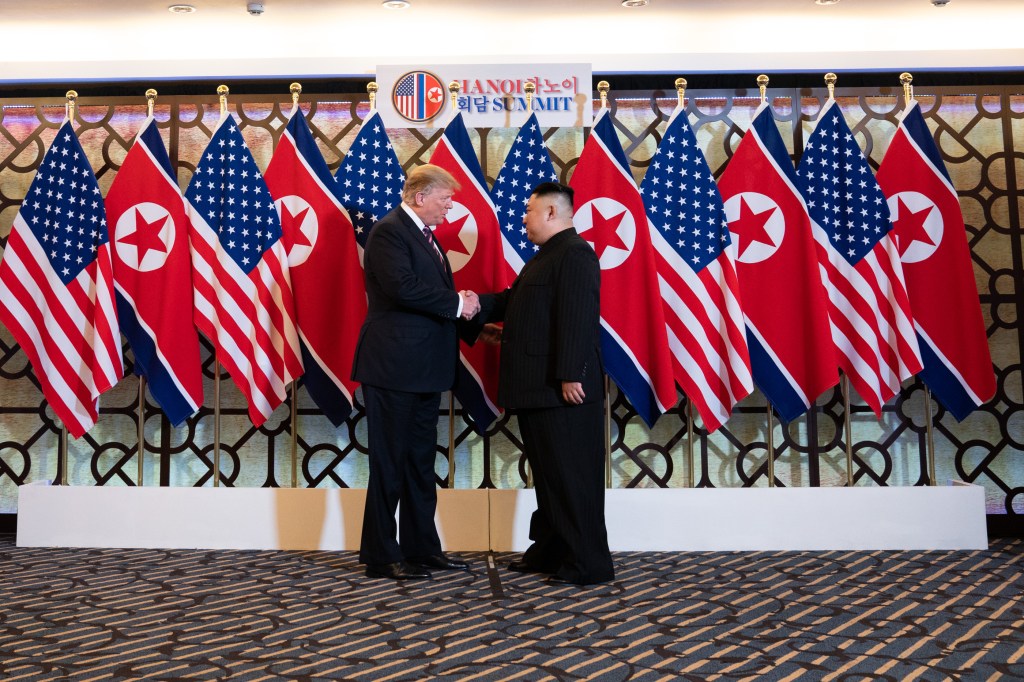
During the 2018–2019 détente with the United States—when Vietnam hosted the now-infamous summit in Hanoi—Kim Jong Un himself invoked Vietnam as a reference point. He envisioned a future in which a denuclearization agreement and a peace framework on the Korean Peninsula would lift sanctions, address North Korea’s security concerns, and remove the main obstacles to economic reforms.
That future never materialized. Today, with Kim rejecting talks on denuclearization and the security environment on the Peninsula sharply deteriorated, discussions of post-denuclearization reforms are largely irrelevant.
However, as Washington looks for avenues to bring Kim back to the table, the Vietnamese experience offers other lessons that could be usefully applied to the North Korean context.
Kim Jong Un’s policy shift and the problem of re-engagement
Since the breakdown of talks in Hanoi and Panmunjom in 2019, the space for renewed US–DPRK engagement has narrowed considerably. Kim Jong Un appears to have fundamentally redefined North Korea’s foreign policy and strategic goals, continuing to signal a deliberate policy of distancing from both Washington and Seoul—even under pro-engagement administrations in both capitals.
The security environment on the Peninsula has deteriorated. As Kim Jong Un walks away from Washington and Seoul, his narrative keeps moving steadily toward an adversarial posture that casts the United States and South Korea as enemies and frames military confrontation as both necessary and inevitable. In September 2025, he made clear that the new position of the DPRK is irreversible: there will be no more talks on denuclearization.
Pyongyang’s hostile disengagement and affirmative no-denuclearization stance has widened the strategic-narrative gap with Washington, rendering US re-engagement efforts based on the now outdated frameworks of Singapore and Hanoi unsuccessful.
The limits of personal diplomacy
Many hoped that Donald Trump’s return to the presidency would reverse this trend and revive bilateral diplomacy with Pyongyang. The main source of optimism was Trump’s personal relationship with Kim Jong Un—a relationship that appeared to survive the Hanoi breakdown and is frequently presented as a key channel for re-engagement. Kim has signaled a conditional openness to a meeting with Trump, noting that he retains “a good memory of the current US President Trump” and sees “no reason for us not to come face to face” with the United States. But this willingness comes with a clear condition: Washington must “free itself from its absurd pursuit” of denuclearization.
This statement captures the core impasse. Kim is open to meetings, but rejects re-engagement on the terms of Singapore and Hanoi. Unless Trump articulates a fundamental shift in US policy, Pyongyang will continue to avoid what it now sees as dead-end diplomacy. After the humiliation suffered in Hanoi, Kim will take no risks: he will need to know precisely what he is walking into and be able to control the outcomes. For Kim to agree to another meeting, Trump would need to define a clear purpose that explicitly excludes denuclearization and to offer tangible—preferably financial—incentives.
Washington and Pyongyang are not ready for a deal
In this context, denuclearization talks should be set aside. Under current conditions, they are bound to fail—and pressing them would foreclose opportunities to reduce tensions or re-engage Pyongyang.
However, under the current state of affairs, even that won’t be enough to bring Kim back to the table. Without first addressing the deeper disconnect between the two countries, any attempt to negotiate interest-based compromises is likely to fail. Washington and Pyongyang are not ready to sit down and negotiate any agreement, and pressing for a deal prematurely would likely backfire: negotiations that sidestep denuclearization without a clear plan risk either US concessions without reciprocity or a humiliating collapse for both leaders, causing political backlash in both Washington and Pyongyang. The traditional model of “talks about talks” is also ill-suited to the current moment, as it still forces both sides into a deal-oriented posture while their underlying visions remain incompatible.
What is needed now is a space for engagement that allows Washington and Pyongyang to address their mutual hostility and recalibrate their approaches before negotiating outcomes.
Reconciliation as a necessary first step
Re-engagement will now depend on whether Washington understands that it must take a step back before it can move forward. The necessity of sustained engagement with Pyongyang as a precondition to addressing the most sensitive issues has been emphasized time and again by former negotiators and mediators. Former US Special Representative for North Korea Stephen Biegun even highlighted the importance of an early opening of liaison offices to preserve communication when formal diplomacy stalls.
In this context, prioritizing reconciliation over a deal could provide the time and political space needed to unlock diplomacy without requiring major concessions from Washington. Reconciliation should be understood as the opening phase of a sequenced process—one aimed at stabilizing, and eventually normalizing, the political and security environment on the Peninsula. As North Korea’s siege mentality deepens and hostility toward both the United States and South Korea intensifies, shifting Kim’s adversarial trajectory should be Trump’s immediate priority. Reducing risk and stabilizing the Peninsula is not a concession to Pyongyang, but a prerequisite for any future agreement.
The Vietnam reconciliation model
It is here—not in post-denuclearization economic reform—that Vietnam offers its most relevant lesson for US-DPRK diplomacy today.
Despite the Paris Peace Accords, relations between the United States and reunified Vietnam were deeply hostile in the postwar period. As former Vietnamese ambassador Lê Văn Bàng recalled, “relations between Vietnam and the United States were so bad we could not talk about anything but MIAs and POWs.”
Over time, cooperation on war-legacy issues—particularly POW/MIA recovery and Agent Orange remediation—evolved “from a subject of anger and resentment to one of appreciation and cooperation.” These joint field operations became the first substantive cooperative activities between the two former adversaries.
From the late 1980s until formal normalization in 1995, the MIA program laid critical groundwork for broader engagement, eventually expanding into cooperation on landmine removal and assistance to war victims — steps that proved instrumental in enabling full normalization of relations. Crucially, the domestic salience of the POW/MIA issue in the United States created political legitimacy for reconciliation with a former enemy.
Unlock re-engagement through MIA recovery
Since the early 1990s, US-DPRK cooperation on MIA recovery has repeatedly featured in diplomacy as a humanitarian Confidence-Building Measure (CBM) and a potential step toward normalization of relations, including during the first Trump administration. However, like other areas of cooperation, it remained subordinate to denuclearization talks. Once the Hanoi negotiations collapsed, this cooperation unraveled.
Rather than attaching CBMs to an elusive grand bargain, Washington could relaunch engagement by focusing exclusively on MIA recovery as a stand-alone process. Engagement without denuclearization on the table would expose the administration to sharp criticism. Only an issue such as MIA recovery—one that continues to resonate strongly with the American public—can make diplomatic engagement with Pyongyang politically defensible in Washington without requiring explicit reference to the nuclear program. MIA recovery is also sufficiently non-sensitive for Pyongyang, particularly if accompanied by a significant U.S. financial contribution to cover associated costs.
From there, cooperation could gradually expand to similarly structured initiatives—joint demining in the DMZ, climate-disaster response, or nuclear safety—while postponing more contentious issues until on-the-ground cooperation has created a more solid diplomatic foundation.
A step-by-step path forward
Although Washington sees post-war Vietnam and today’s North Korea very differently, Pyongyang’s view of US–DPRK relations today places them close to where US–Vietnam relations stood at the end of the war. Therefore, drawing on the US–Vietnam historical pathway could help Washington align more closely with Pyongyang’s own reading of the relationship—one shaped by hostility rooted in a Korean War that never formally ended.
In this context, if Washington were to accommodate Pyongyang’s perspective and act as if the Korean War had just ended—following the same step-by-step path it once pursued with Vietnam—this could allow the United States and North Korea to build trust incrementally toward normalization of relations, creating conditions under which a deal, and perhaps even talks on denuclearization, become politically viable.
Unlike the “talks about talks” format, concrete cooperation on MIA recovery would necessitate liaison offices, as recommended by Biegun, and would require concrete steps to reduce tensions on the Peninsula. These could include reviving the 2018 moratorium on nuclear and missile testing and adjusting US-ROK military exercises that explicitly target the Kim regime.
Trump’s personal relationship with Kim is no shortcut to a deal, but it could be leveraged to initiate a process of reconciliation—without preconditions or permanent concessions—that moves both sides out of strategic paralysis and back toward diplomacy. The US experience with Vietnam offers a viable roadmap.
Marialaura De Angelis is YPFP’s 2025 Rising Expert on Multilateralism and Diplomacy. She is a geopolitical analyst specializing in the Indo-Pacific, with deep expertise in U.S. and EU policies, strategies, and engagement in the region—developed over fifteen years across the EU institutions, the private sector, international think tanks, and the NGO field.

 Charged Affairs