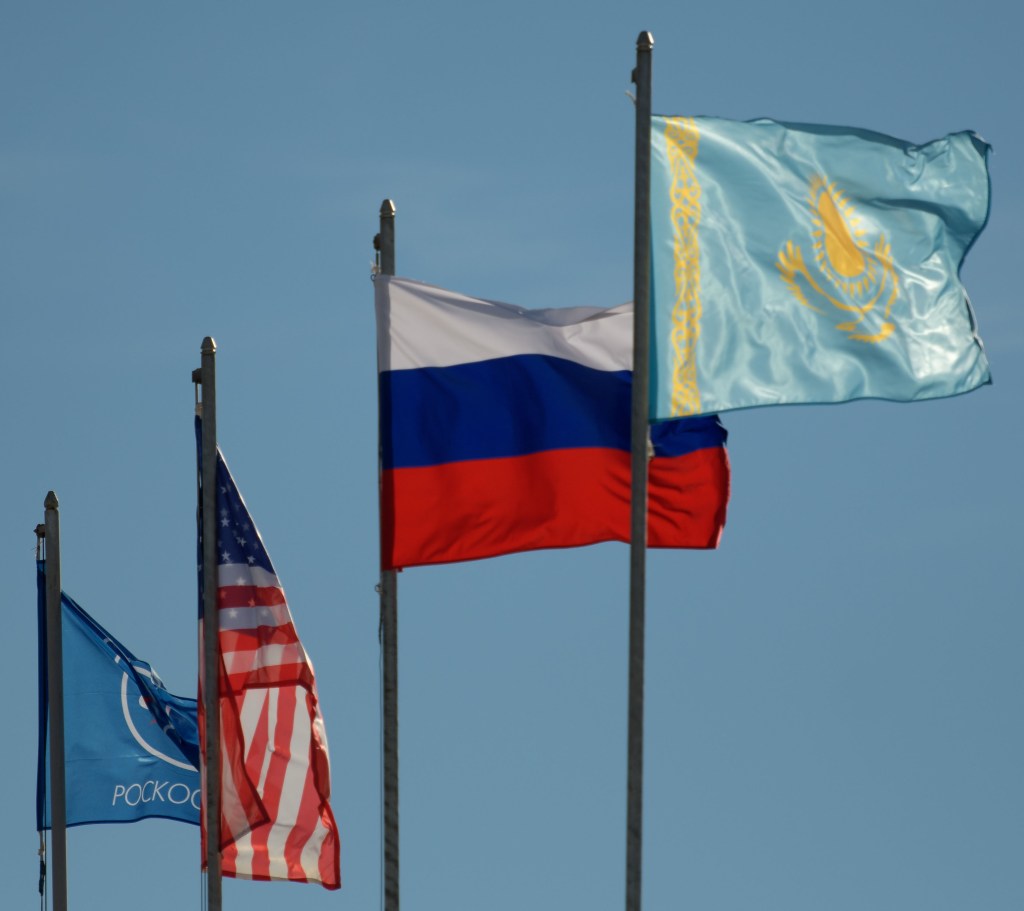
By Claire Astrid Fuchs | Rising Expert on Geostrategy | February 26, 2026 | Photo Credit: Flickr
Central Asia stands at a crossroads. The region’s future will be shaped not by which great power prevails, but by whether Central Asian nations can sustain multi-vector diplomacy while pursuing economic diversification.
Central Asia has entered a new era of great power competition. Though the region has been dominated by Russia historically, the geopolitical landscape of Central Asia has shifted dramatically in recent years, particularly since the 2022 invasion of Ukraine. As Western sanctions have constrained Russian firms, the region has continually sought alternative partnerships, transforming Central Asia into an increasingly dynamic and contested space where China and the United States vie for influence with Russia’s legacy. This competition will depend on how Central Asian nations like Kazakhstan and others can position themselves as strategic brokers, rather than as passive pieces on a geopolitical chessboard.
Great Powers and the Road to Plan 2030
As great powers look to influence Central Asia, each brings their distinct advantages in promoting development and security, particularly in supporting the region’s Plan 2030 objectives. These national strategies seek to strengthen security and territorial integrity while growing their market-based economies on seven long-term priorities: economic pragmatism, entrepreneurial support, social policy, professional skills training, democratic institutions, regional security, and patriotism.
Russia provides ready access to labor and energy markets, security guarantees through organizations like the Collective Security Treaty Organization (CSTO), and legacy petroleum infrastructure dating from the Soviet era. However, Russia’s economic stagnation and the spillover effects of Western sanctions have diminished its attractiveness as an investment partner.
China meanwhile can offer substantial capital through its Belt and Road Initiative (BRI), as well as access to East Asian markets and manufacturing partnerships. The recent opening of four Shanghai Cooperation Organization (SCO) centers in Central Asian capitals moreover demonstrates Beijing’s commitment to deepening institutional ties across the region.
The United States finally provides advanced petroleum extraction technology, institutional capacity building, and investment standard setting—though its political influence remains weaker than that of Russia and China. American engagement operates primarily through bilateral channels and multilateral forums like the C5+1 dialogue, founded in 2015 for annual meetings between foreign ministers.
Kazakhstan: The Exemplar of Multi-Vector Diplomacy
Kazakhstan illustrates how countries in Central Asian nations are navigating this great power competition. Its economy, the region’s largest economy with a GDP of USD 288 billion, focuses heavily on oil and gas while slowly diversifying, and energy geopolitics have shaped its strategic importance. Billions in investment have flowed into pipeline construction, oilfield development, and transit routes like the Central Asian Rail Corridor and the Trans-Caspian International Transport Route.
Russia has historically played a crucial role in Kazakhstan’s development, particularly by providing seaport access for energy exports and earning transit fees in return. Russia and Kazakhstan remain connected through language, migration, tourism, and security treaties like the CSTO. However, these traditional levers of influence face growing constraints. The CSTO’s utility has been called into question after member states denied Armenia’s Article 4 request for support during Azerbaijan’s border demarcation attempts at a ministerial summit in Dushanbe. This failure exposed the organization’s limitations and prompted Kazakhstan to question the value of such security arrangements. Combined with Russia’s economic difficulties, Kazakhstan has adopted a policy of structural independence rather than political loyalty to Moscow.
China meanwhile has served as a new economic anchor for Kazakhstan’s rapidly developing economy.China’s BRI has invested heavily in projects like the Khorgos Gateway and various economic corridors, significantly strengthening Kazakhstan’s logistical connectivity and transport infrastructure. The World Bank estimates these infrastructure investments could improve Kazakhstan’s GDP by 6.5%, with trade facilitation potentially adding another 15%.
Beyond BRI projects, China engages Kazakhstan bilaterally and through the SCO, which provides a stabilizing political framework and serves as a norm-setting institution. Yet China faces its own constraints. Domestic concerns over Chinese influence emerged during nationwide protests in 2019, reflecting anxieties about asymmetric bargaining power and threats to economic sovereignty. Despite these tensions, China continues serving as a demand anchor and logistics partner crucial to Kazakhstan’s Plan 2030 goals.
The United States finally has worked as a counterweight. Western oil companies, particularly Chevron and ExxonMobil, have solidified their presence through the Tengiz and Karachaganak oilfields. Engaged in Kazakhstan since the late 1990s, Chevron has become Kazakhstan’s largest private oil producer. These companies provide capital-intensive extraction technology, managerial expertise, and long-term investment stability. American foreign direct investment proves most effective when aligned with domestic reform priorities like Plan 2030 and when it complements rather than confronts investment from other nations.
The United States also engages through security cooperation, including counterterrorism and border security training with Kazakhstan. Critically though these provisions often do not demand political alignment, allowing Kazakhstan to maintain economic sovereignty while improving diversification.
Strategic Pluralism as the Path Forward
Kazakhstan’s approach—and increasingly that of its Central Asian neighbors—synthesizes cooperation with all three great powers by recognizing their complementary roles. Russia serves as a transit gatekeeper, China as a demand anchor and financier, and the United States as a provider of technology and skilled expertise. This framework allows competition and cooperation to coexist without any single power acting as a political patron.
The key to Kazakhstan’s success lies in maintaining what might be called “structural independence”—allowing cooperation to coexist without any single power acting as a political patron balancing relationships with competing powers to preserve autonomy. The coming decades will test whether Kazakhstan’s model can spread across the region. The region’s future will be shaped not by which great power prevails, but by whether Central Asian nations can sustain multi-vector diplomacy while pursuing economic diversification. Kazakhstan demonstrates that this is possible—indeed, it may be the only viable long-term path.
Claire Astrid Fuchs is an Eisenhower Global Scholar at the University of Oxford’s Blavatnik School of Government where she is pursing a Master of Public Policy, studying the nexus of national security policies and human rights, bridging her humanitarian background with her national security expertise. She is an Analyst II for Janes on the Geoeconomic Influence & Threat Intelligence team, where she tracks Russian and Chinese foreign investment and associated security risk globally, with a focus on their investment activity in the Middle East, North Africa, and Persian world to provide contextual analysis when multiple state and non-state actors are involved in the investment zones. She is a 2025 YPFP Rising Expert on Geostrategy.
 Charged Affairs