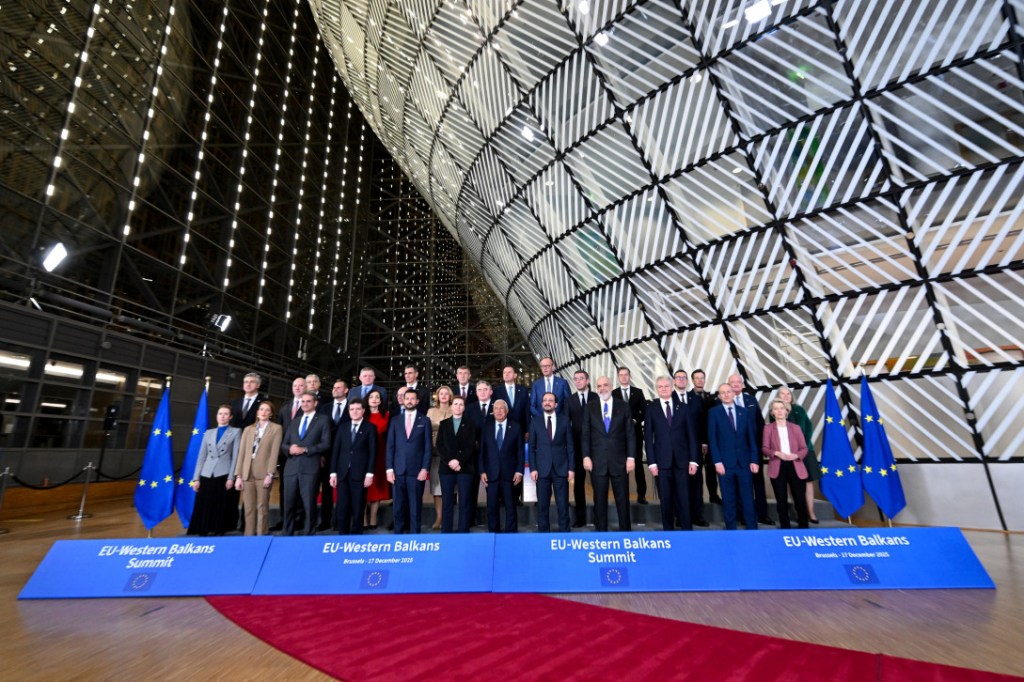
By Stoycho Velev | Rising Expert on Eastern Europe | March 6, 2026 | Photo Credit: European Union
The EU–Western Balkans Summit on 17 December 2025 was never expected to deliver grand announcements. Beyond the usual affirmations, enlargement hardly dominated the European Council agenda at the end of the year, as the meeting took place on the same day and amid lingering disagreements over the Mercosur trade deal and intense internal debates over how to finance Ukraine’s war effort.
At the time of the summit, the six Western Balkan countries stood at markedly different positions along their respective accession paths. Montenegro remains the frontrunner, having opened all negotiation chapters and provisionally closed several. Albania has gained momentum in recent years and, despite rule-of-law concerns and corruption scandals, is now widely regarded as second in line. North Macedonia continues to face political obstacles that have stalled its progress, while Bosnia and Herzegovina, despite opening talks in 2024, still trails behind due to political fragmentation and the country’s specific institutional challenges. As Kosovo remains at the very beginning of its EU bid, Serbia’s position – amid its most unfavorable Enlargement report in over a decade- was best characterized by the absence of its President Aleksandar Vučić from the meeting.
Besides constituting another attempt to lift the spirits of all six countries that have been standing in the EU waiting room for a very long time, the summit also reflected an increasingly familiar mood in Brussels: enlargement remains strategically important, but deeply contested – not only in terms of timing and credibility, but increasingly in terms of what accession itself should actually mean.
Indeed, the summit’s final declaration reaffirmed the commitment to the Western Balkans, painting enlargement as “a key geostrategic investment in peace, security, stability and prosperity”, once again underlining that the future of the region lies within the Union’s institutional borders. However, looming over the discussions was a recently floated idea and an increasingly central dilemma: whether the next batch of countries will join the EU on the same basis as those that came before them. As the EU Commissioner for Enlargement Marta Kos has frequently implied, questions are now openly being raised about whether full membership, as traditionally understood, remains the default outcome, or whether the rules of accession should be rewritten.
At the heart of this new line of thinking lies the revolutionary, albeit controversial notion that new member states could join the EU without immediately enjoying full voting rights, placing certain key powers – most notably veto rights within the foreign and security policy domain – on hold for a defined “probation period.”
This has been floated and recently dubbed ‘reverse enlargement’, concerning not only the Western Balkan states, but accession aspirants such as Ukraine and Moldova. Such a model is also said to provide a safeguard against newly admitted countries in cases of democratic backsliding, thus making enlargement a more “sustainable” process.
Setting such a precedent, however, raises serious questions as it is unclear how far such reforms would go and whether there would be a new adaptation or a complete overhaul of the Copenhagen criteria – the 1993 framework that sets the political, economic, and legal conditions for EU membership, against which every candidate country has been assessed ever since.
But in practical terms, it seems that new members could see themselves temporarily giving up some of the rights that have traditionally defined EU membership to only acquire them later, once specific political and institutional conditions are met. A phased approach of this kind could, for instance, involve waiving veto powers in unanimity-based Council areas or initially foregoing the appointment of a national Commissioner.
Still, new member states are to enjoy most advantages of the ‘EU club membership’ immediately upon joining. Even without holding a decisive vote at first, their representatives would contribute to Council meetings and hold observer or consultative roles. Their citizens would gain EU citizenship rights, access the Single Market, benefit from EU funds, and come under the EU’s legal order and jurisdiction (including the right to recourse to the European Court of Justice).
This approach, already underway via the European Commission’s €6 billion Growth Plan for the Western Balkans, allows the region to plug into parts of the EU single market and programs early, serving as an incentive and a preparation for membership.“We are working intensely on gradual integration – the groundwork of accession,”, Commissioner President von der Leyen recently noted, emphasizing that the Growth Plan lets the Western Balkans “enjoy some benefits of integration even before full membership”.
Ideally, any restrictions for the rest would last for a fixed probation period or until the EU carries out major institutional reforms. This way, the bloc hopes to reassure current member states who fear that newcomers could hijack major aspects of EU policymaking, as it is hardly a public secret that urgent matters have recently been marked by internal deadlock – from Ukraine funding to the EU-Mercosur trade deal, to migration.
Handling an already strained decision-making system, the message from Brussels seems to be that enlargement must remain credible but also manageable, gradually strengthening the Union without undertaking too great a risk.
While undeniably a promising idea, the delicate balance the proposals rest on would be tricky to hold and could eventually play into the hands of eurosceptics across the region – both within the newcomers who see their integration only partially complete, and those within current members who would cast doubt on whether these newcomers would ever achieve full alignment to EU standards.
This is also consistent with enlargement being increasingly perceived by some as a geopolitical tool and a means of preventing external actors from gaining influence in the Western Balkans, which, even if it proves to be an effective method, also carries its own contested implications. For some, enlargement might be becoming less about completing the European project and more about responding to external challenges.
As it always has, the EU’s gradual expansion remains both a strategic necessity and a test of the Union’s credibility. Indeed, there are real challenges in the Western Balkans, including unresolved disputes, rule-of-law deficits, and political instability. There is also undeniable enlargement fatigue among member states. Yet treating accession primarily as a technical or geopolitical fix risks overlooking its deeper political meaning.
While the initiative is still at an early stage and would require unanimous backing from all EU leaders in the Council, its political significance is already evident. Notoriously, almost every enlargement summit usually ends up walking a “tightrope” between hope and realism, and this one was no exception.
Whatever unfolds in the next few months, it would be wise to remember that even though Europe’s security and geostrategic interests remain crucial, a long-standing, merit-based process, grounded in the values and conditions set out in the EU treaties and the Copenhagen criteria – once a golden standard for an ambitious and visionary Union – should not be lightly tossed away.
Stoycho Velev is a Master of Laws (LL.M) graduate from Sofia University. He is part of the 100th Hague Academy of International Law class at the International Court of Justice and the 2021-2024 European Politics and Society ‘Vaclav Havel’ Master’s Degree cohort. He studied in Prague, Kraków and Leiden, with an academic focus on European security and defence policy in a transatlantic context and conducted research on the perspectives of Eastern European states. He is the Bulgarian representative at the 2025-2026 European Diplomatic Programme by the EEAS. Stoycho has held positions in the Bulgarian civil service and the European Commission, and has authored articles on European and global affairs for various outlets, both domestically and internationally.

 Charged Affairs