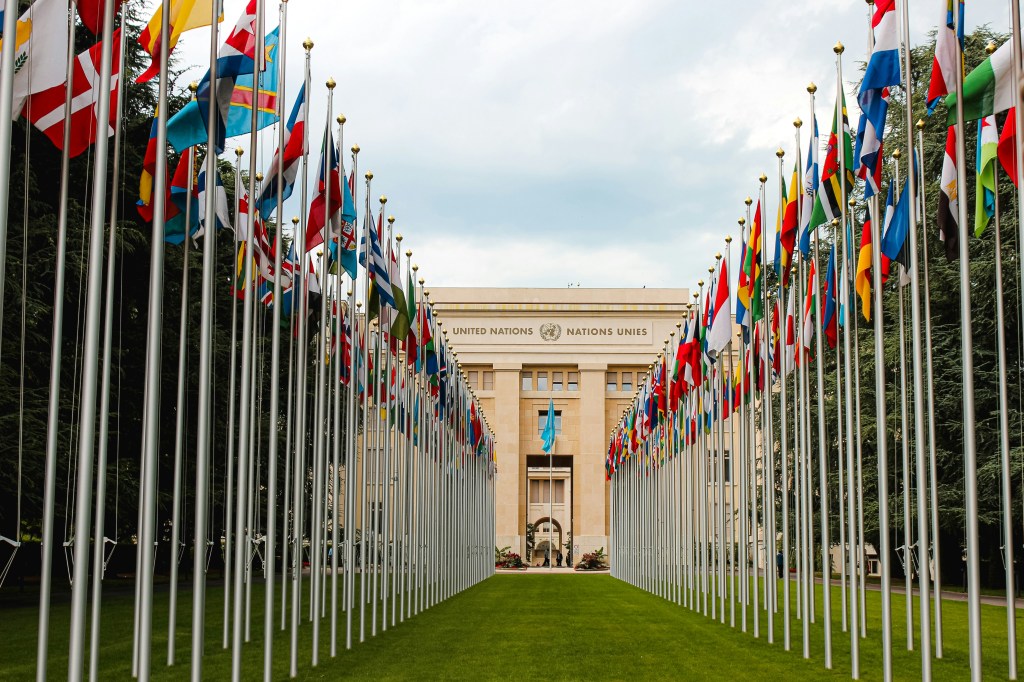
By Alexandra Huggins | 2026 Rising Expert on Human Rights | May 7, 2026 | Photo Credit: Mathias Reding
The UN is in the midst of confronting crimes against humanity on both sides of the Atlantic. On April 23, 2026, the International Criminal Court in the Hague confirmed all charges against former Philippine President Rodrigo Duterte, including three counts of crimes against humanity, sending one of the most consequential cases in the Court’s recent history to trial with a former head of state. Duterte’s charges come from his decade-long “war on drugs,” where he is accused of authorizing and enabling a widespread and systematic campaign of extrajudicial killings targeting alleged drug users and dealers. A week later in New York, states are due to submit amendments to the draft Crimes Against Humanity Convention by April 30, placing international criminal law at a key test between international human rights principles and political will. The Duterte case exposes three key considerations that delegates must confront in negotiations over the Convention: enforcement dependent on state cooperation, the gap between formal recognition of victims’ rights and their realization, and delayed justice.
- Political Realities of Enforcement
The Duterte case demonstrates the difficulty of enforcement in international criminal law, as his arrest seemed due to a domestic power struggle rather than any true commitment to international justice. A persistent obstacle facing the International Criminal Court is its lack of an enforcement mechanism, which leaves it reliant on the political will of member states to execute arrest warrants. Many current and prior ICC cases have been dragged down by non-cooperation from states, as individuals such as Vladimir Putin, Benjamin Netanyahu, and Omar al-Bashir, the former president of Sudan, have all been charged with crimes against humanity or war crimes yet evaded arrest and travelled freely even within states formally obligated to cooperate with the Court.
Al-Bashir, and now Duterte, only faced justice following changing domestic political circumstances, with Duterte’s arrest following a fallout between the Marcos administration and the Duterte political camp. President Marcos initially refused to engage with the ICC, but reassessed after a power struggle and cooperated with an Interpol request tied to the ICC warrant, resulting in Duterte’s arrest. Both the timing and the broader political circumstances indicate the Philippine government’s cooperation was strategic rather than indicative of any commitment to justice. Drug-related killings have continued under the Marcos administration, with hundreds killed since he entered office, and no domestic charges have been filed against Duterte or any officials.
The Crimes Against Humanity Convention faces the same issue of political will. In early discussions, countries like Russia, China, Iran, and North Korea have sought to dilute the document, advocating for the immunity of officials from foreign criminal jurisdiction and non-intervention in domestic affairs of states. The Convention will have to address the tension between the formal acceptance of its principles and the reality of their enforcement, as its effectiveness may very well be dependent on the willingness of states to act against their own political interests or those of strategic allies. Currently, the Convention’s draft includes state obligations to criminalize and investigate crimes against humanity, but its eventual effectiveness will likely depend on whether states are willing to de-prioritize short-term political considerations in favor of international justice and accountability. The Convention needs to consider how to ensure that its provisions are supported by mechanisms that can withstand political reluctance and selective enforcement by states.
- The Victims’ Rights Gap
From a human rights standpoint, the underlying issue in international criminal justice goes beyond the prosecution of crimes against humanity to whether victims actually obtain justice and remedies in practice. While the ICC and domestic courts — the primary fora in the Crimes Against Humanity Convention draft — can prosecute a limited number of representative incidents and provide reparations to victims, they are ill-equipped to address the full scale of mass harm alleged in cases like Rodrigo Duterte’s “war on drugs.” Doing so would require resources and political will far exceeding what the ICC or most domestic systems can realistically sustain. Estimates of the death toll from Duterte’s “war on drugs” range from 6,000, according to domestic police statistics, to over 30,000, according to human rights groups. Yet ICC court documents list only 76 specific murders while acknowledging that the actual number of victims is in the thousands.
True justice for all those affected would require substantial time, effort, resources and political will. The current draft of the Convention does stipulate that states must provide reparations to victims of a crime against humanity within its territory, which may include restitution (restoring the victim’s original situation), compensation (financial payment), rehabilitation (medical and psychological care), and satisfaction (measures verifying the facts, publicly disclosing the truth, and assisting in the recovery, identification, and reburial of victims). However, the Duterte case serves as an example of the gap between law and justice for victims, as the establishment of mechanisms for collective claims and reparations requires sustained political will and dedication of resources both from the state in question and international actors. For example, the gacaca courts following the Rwandan genocide, depended on long-term state engagement, extensive community-level participation, and sustained international financial, technical, and monitoring support.
Even with a Convention recognizing the rights of victims, their realization must overcome political resistance and limited administrative capacity. Governments implicated in crimes against humanity will likely resist acknowledging wrongdoing or refuse to allocate resources toward reparations, such as in the Philippines, where the drug killings have continued. At the same time, international mechanisms such as the International Criminal Court depend on state cooperation and do not possess the funding or the mandate to organise widespread reparations. These barriers are an important consideration for the Convention, as while it recognizes victims’ rights, it does not address the institutional or political conditions necessary to realize them. The Convention cannot stop at merely recognizing the rights of victims and must factor in the mechanisms and processes needed to realize justice for those affected by crimes against humanity. If not, accountability frameworks may continue to concentrate on cases where governments are willing and able to act, or where international pressure can be maintained, while the majority of victims remain beyond the reach of both prosecution and remedy.
- Delayed Action
A further lesson from the Duterte case is the need for monitoring mechanisms that operate before and during alleged crimes against humanity. Duterte’s “war on drugs” unfolded over a decade, beginning in 2011 and continuing into the 2020s, with thousands of killings reported by both domestic and international observers. During this period, international engagement was limited to statements of concern, advocacy by civil society, and limited engagement by the International Criminal Court, which only began a preliminary investigation in 2018 and formally authorized a full investigation in 2021. While human rights organizations repeatedly raised alarms, there was no institutional mechanism dedicated to monitoring, investigating, and advocating for compliance with obligations specific to crimes against humanity as they occurred. This delayed and inconsistent response illustrates an important gap between early warning and action by international legal institutions.
Other human rights conventions incorporate dedicated monitoring bodies into their frameworks. For example, the Committee Against Torture was established under the Convention against Torture and Other Cruel, Inhuman or Degrading Treatment or Punishment and provides ongoing oversight through state reporting, inquiries, and individual complaints and the Committee on Enforced Disappearances monitors the implementation of the Convention for the Protection of All Persons against Enforced Disappearance by the States. These mechanisms provide oversight and monitoring that can bring attention to violations earlier and sustain pressure on states over time. The need for such an office was evident through the Genocide Convention, which did not establish a monitoring body at the time of its ratification. However, the failure of the international community to prevent the Rwandan and Bosnian genocides resulted in the creation of the UN Office on Genocide Prevention and the Responsibility to Protect in 2004.
The Duterte case exemplifies why such a mechanism is necessary. Without a body dedicated specifically to monitoring, review, and reporting obligations tied to crimes against humanity, the international community risks a delayed, fragmented response to large-scale abuses rather than providing consistent oversight as violations unfold. Incorporating a treaty body or similar monitoring mechanism into the Convention would not guarantee compliance, but it would help bridge the gap between the text of the Convention and prevention and accountability. While the Convention is focused around state responsibility and obligation to prevent crimes against humanity, the inclusion of a treaty body could strengthen the Convention’s efforts to prevent and address crimes against humanity before they escalate, by creating oversight and reporting mechanisms that identify patterns of abuse earlier, maintain international attention, and reduce the likelihood that widespread violations proceed for years, as with the Duterte case.
Conclusion
The Duterte case will be close at mind for the New York delegates in the Crimes Against Humanity Convention discussions in the coming years. The realities of enforcement, the nuances of victims’ rights, and the necessity of a prompt, sustained response to violations will be important issues for delegates to grapple with as negotiations continue and the final structure of the Convention is refined, ensuring that the Convention is both principled in design and effective in practice.
Alexandra is a recent M.A. graduate from the Johns Hopkins School of Advanced International Studies specializing in international human rights law and the role of multilateral diplomacy and global governance in advancing human rights. Named the 2026 Rising Expert in Human Rights by Young Professionals in Foreign Policy, Alexandra has held positions at the European Union Delegation to the United States’ Political, Security, and Development Section, the Council on Foreign Relations’ International Institutions and Global Governance program, the Carnegie Endowment for International Peace’s Global Order and Institutions program, and the International Crisis Group. Alexandra has been published by the Carnegie Endowment and the Yale Journal of International Affairs. While at Johns Hopkins, Alexandra served as the Editor in Chief of The SAIS Review of International Affairs and examined whether international law provides a right to restorative justice for past human rights abuses in Namibia through the International Human Rights Law Clinic. She also graduated with a B.A. in Peace, War, and Defense with distinction from the University of North Carolina at Chapel Hill where she was inducted into the Order of the Golden Fleece.