By Emma Isabella Sage | June 26, 2026 | Photo Credit: Egor Myznik
Soviet logic is back — with ominous implications.
Yesterday in Moscow, Russian Foreign Minister Sergei Lavrov advanced a familiar but perpetually confusing argument: that Western support for the Ukrainian government proves that the modern European Union “adheres to the values of Nazism.” Russian justifications for the war in Ukraine have always had a hallucinatory quality, but none so much as the claim that Russia is fighting Nazis. Ukraine has no strongman government, no racist laws, and certainly no plans for mass extermination of any ethnic minority. Its far-right parties are marginalized and its president is Jewish. By any observable measure, there is nothing to denazify, and yet Russia still fixates — solemnly, obsessively — on Nazism.
Most Western commentary treats this as either low-effort mudslinging or a half-baked grasp at the glory days of the Great Patriotic War (their name for the portion of WWII during which they fought on the winning side). Viewed through the lens of Soviet history, the origin of the denazification rhetoric becomes clear, and it foretells a dark future for occupied Ukraine.
Misreading Russia’s intentions has already resulted in months of strategically naïve and fruitless American negotiations. Any serious effort to broker a durable settlement requires an understanding of not just Russia’s demands, but the ideological framework in which they are based and the extent to which they are predictors of Russian behavior.
The physical wall
To understand Russia’s “denazification” rhetoric, don’t look to Hitler’s Third Reich — look to Soviet East Germany (the DDR). Specifically, consider the DDR’s name for the Berlin Wall: the Antifaschistischer Schutzwall, or Anti-Fascist Protection Rampart. (Most people just called it the Wall.)
The DDR’s official line was that the Wall wasn’t meant to keep its own people in, but to keep fascism out. In the Soviet belief system, Nazi status carried over from the war to denote a permanent moral divide between socialist states, which had overcome fascism, and capitalist states, which had preserved its essence. If fascism and communism are seen as opposite ends of the global political spectrum, with communism being considered the final form of human political evolution, then there is a kind of logic in the assertion that a transition from fascism to democratic capitalism would leave a state’s denazification “incomplete.” The Soviets took this to extremes. In the DDR’s political cosmology, to leave the socialist state — or to reject its authority, or look westward for any reason — was to throw one’s lot in with the Nazis. That logic justified the brutality of the death traps which awaited anyone who attempted to cross the Wall’s Todesstreifen, or death strip. It is also the logic by which Russia now justifies slaughtering the Ukrainian people in response to their country’s westward tilt.
In other words, for Russia, the word “Nazi” has long since been stripped of any factual meaning and repurposed to denote a challenge to Moscow’s authority over the post-Soviet space. Under this framework, a fascist is something you become the moment you stop deferring to Moscow. Every democratic choice Ukraine made toward sovereignty and self-governance was, by the Russian definition, a step toward Nazism, and a license to kill for many ordinary Russians.
Revisionist historical treatments of the Wall, like those still available on communist sites and in some academic publications, show that this narrative also survives in parts of the West. The ProleWiki article on the Antifaschistischer Schutzwall states that the Wall was built to protect East Germany from NATO (which it describes as “the largest terrorist organization in the world”) and “to protect the GDR from counterrevolutionary West Germany, where denazification never took place.” As a descendant of those who died in the Holocaust, living safely in Germany while watching calamity befall my friends and community in Ukraine, I find such claims intolerable, but interacting with them is one of many necessary evils inherent in any kind of engagement with Russia.
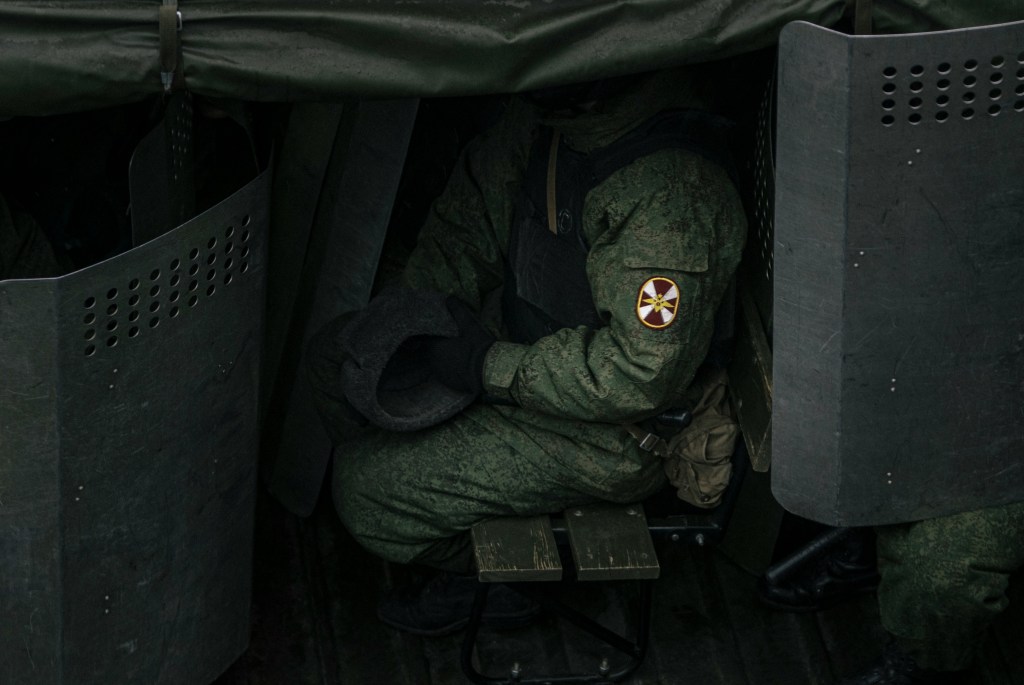
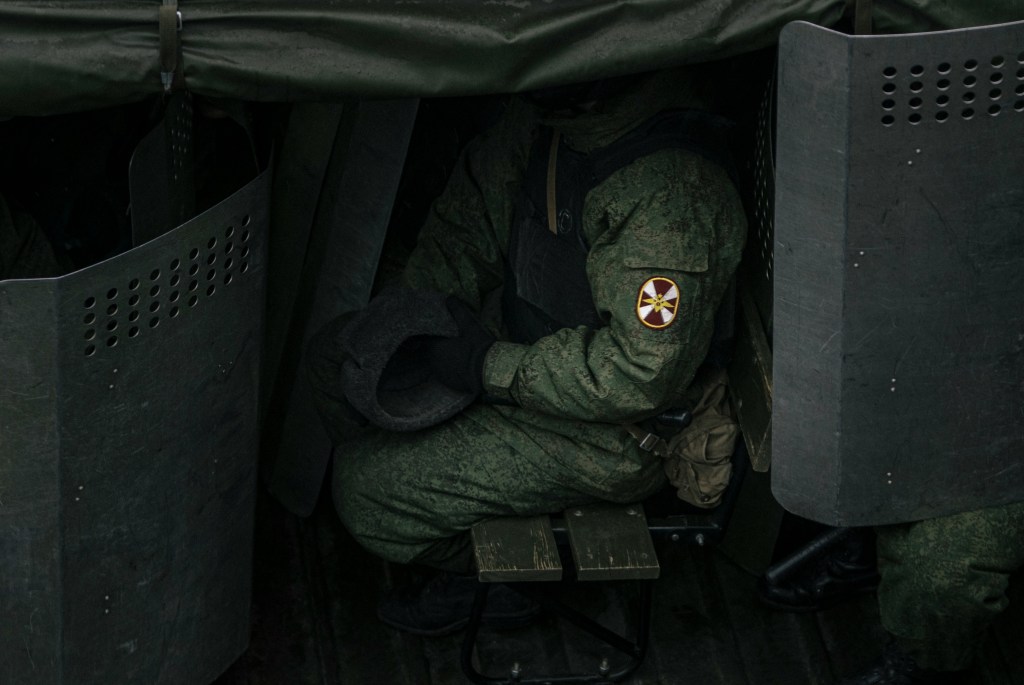
When the USSR collapsed, in the Russian imaginary, the border represented by the Wall still existed in a less tangible form, and has been repeatedly breached through rapprochement between former Soviet states and the West. From Russia’s perspective, with every post-Soviet state that joined NATO or the EU, its de facto empire shrank (regardless of the de jure independence of the states in question). Russia’s recruitment posters and billboards still visually link Red Army soldiers of the 1940s with today’s troops in Ukraine, implying both the continuation of a single righteous war and the validity of Russia’s Soviet-era territorial dominion.
Russia’s imaginary wall is now in grave danger of becoming real again, leaving many freedom-seeking Ukrainians trapped behind enemy lines. In every territory Russia has occupied, it has hastened to reinstall Soviet monuments and erase Ukrainian history, abduct and weaponize Ukrainian children, and engage in barbarity of all kinds. Bringing an end to this will require an accurate understanding of Russia’s belief system and goals, and the current Trump administration has demonstrated neither.
The strategic narrative
Denazification rhetoric is a strategic narrative:a story that imparts political meaning onto a situation, rather than arising organically from the facts on the ground. Such narratives leverage emotional resonance and ideological familiarity. Evidence can’t debunk them, because they were never primarily based on any evidentiary claims. This is why Russian rhetoric on Ukraine has seemed impervious to Western attacks, and millions of Russians wholeheartedly believe that the war on Ukraine has a real and noble goal — because it feels true to them and aligns with their sense of Russia’s character on the global stage. Once this is understood, the hold of the government’s rhetoric on the minds of average Russians becomes less baffling.
Ultimately, the denazification narrative is less about Ukraine than it is about Russia. Putin is contending with an old Russian anxiety: a country too large and ambiguous to fit neatly into any civilizational category, perpetually insecure about its place in the world, neither European nor Asian, not quite a “developed” country but still trying to be a great power. Russia has always been a conqueror, trafficking in the language of might-makes-right, and Russia needs to feel right again.
None of this is good news for those expecting a quick or lasting peace deal. Mistaking the empirical weakness of the Russian narrative for an actionable chink in the Russian armor has left Western politicians operating on the level of communications during a physical fight. Rather than seeking to debunk Russia’s war propaganda, Western governments should have instead registered that this ideological construction does not permit compromise. There is no common ground between those who believe in a country’s right to decide its own future and those who believe that any territory formerly captured by Russia should be under Russian rule once again. This narrative implicates parts of Europe beyond Ukraine, which is somehow still being downplayed even as Russian drones repeatedly strike NATO territory.
Looking to the future, the Kremlin’s stubborn adherence to Soviet-era narratives tips its hand: Cold War narratives betray Cold War intentions. Russia is signaling that if the West cedes territory to the Kremlin and allows a European country to be divided into East and West, the conflict will continue, just in a different form. This is a posture of long-term territorial revisionism. As the parable goes:
“Meet me in the middle, says the unreasonable man. You step forward, he steps back. Meet me in the middle, says the unreasonable man.”
Emma Isabella Sage is a co-founder of the research software startup LIVINI and a research affiliate at the University of Glasgow. She is a 2025 Young Professionals in Foreign Policy Rising Expert in National Security and a 2026 International Strategy Forum fellow.