By Savannah Taylor | Rising Expert on Economics | April 14, 2026 | Photo Credit: Flickr
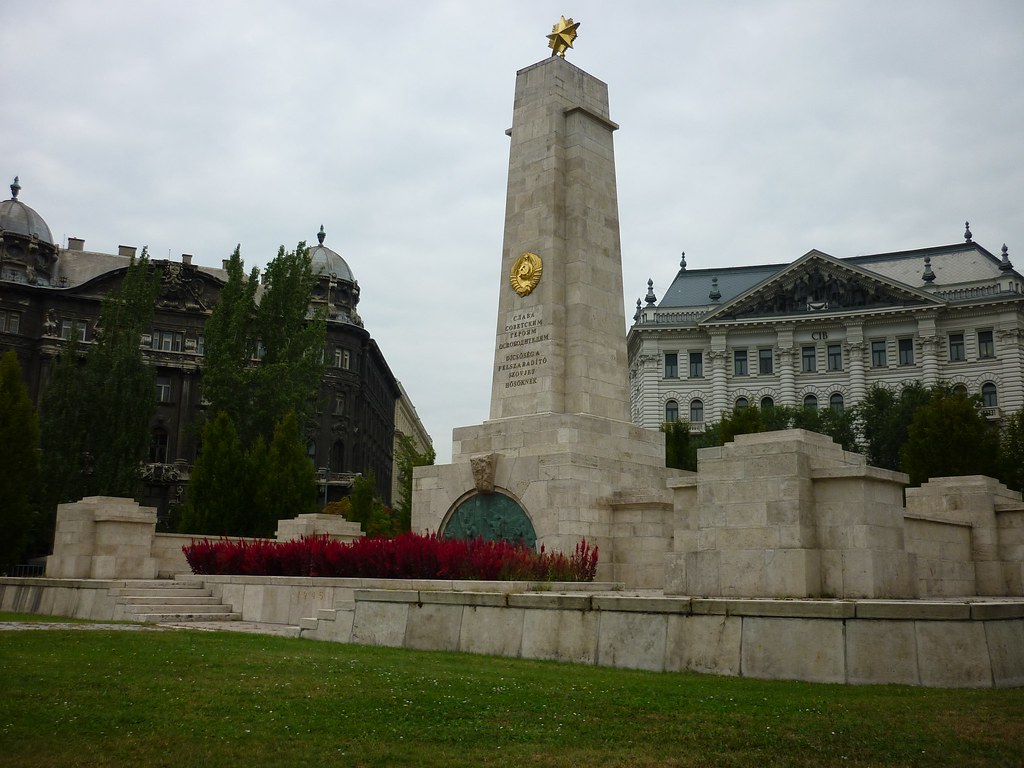
Budapest is renowned for its nighttime lighting, with iconic landmarks like the Parliament building along the Danube. Yet in the city’s Freedom Square, the Soviet Liberation Memorial, kept there after a treaty to remove troops by the then-USSR, remains unlit, a quiet protest by the Hungarian population against former Soviet rule. The persistence of a controversial piece of history in the capital city’s main square serves as an uncanny parallel to the larger challenges the European Union faces: having one foot removed from the defense crisis it faces from the East.
Although the European Union has condemned Russia’s invasion of Ukraine and remains wary of its increasingly volatile, authoritarian neighbor, criticism of the body’s passive response abounds. Most notably, the brunt of European defense responsibility has fallen on the shoulders of just a few states in the East. To adequately address this issue, the European Union needs equitable defense investments to build its deterrence as a united front.
Defense investment within the European Union is notably uneven, with Eastern EU members spending significantly more than their Western counterparts. In 2024, Poland’s defense spending accounted for 4.2% of its GDP and the Baltic states’ expenditure was approximately 3%. This is almost triple the percentage in Western EU countries, such as Germany, Ireland, and Spain. Although NATO members (including all but four EU states) increased their military spending in 2024, there is disproportionately more military spending from the six countries bordering Russia: Poland, Norway, Finland, Estonia, Latvia, and Lithuania.
Although the European Union is built on a foundation of unified democratic resilience, uneven defense capacities among EU members risk gradually fracturing collective security, leaving the most exposed states abandoned while others remain insulated. If only a few players feel the direct weight of this disparity, distrust and resentment could grow, creating a weakness for bellicose states to exploit. Interdependence – both militarily and economically – is often the key building block of alliances, which the European Union is putting at risk by letting the weight of this conflict in the East fall solely on the countries closest to it.
No two countries better illustrate the power of economic interdependence than Belarus and Russia. Belarus has experienced and felt new strength from its close economic relationship with Russia, an advantage that EU states lack in this challenging geopolitical climate.
The case of Belarus demonstrates how existing ties can evolve into a structural dependency, in which unaddressed economic overreliance becomes a security threat. Belarus has long aligned politically and culturally with Russia, sharing historical ties before and during the Soviet Union and an authoritarian governing model. But these connections do not inherently require a strong alliance; instead, a state being “pushed” away from Europe can demonstrate how economic fragility can bind it more closely to a stronger power, making it a more potent threat to the EU.
Belarus relies heavily on subsidized Russian oil and gas, while having limited access to global finance. As a result, it lacks the resources and independence to stand on its own. Russia capitalized on these vulnerabilities to further entrench Belarus in this trade relationship at a time of economic insecurity, using energy subsidies, bilateral trade, and transit for Belarusian exports and capital inflows, particularly after the highly disputed 2020 Belarusian election, thereby increasing Western sanctions on Belarus. While sanctions have historically been a powerful tool, EU sanctions imposed on Belarus and Russia in 2021 proved somewhat ineffective. Belarus was able to circumvent sanctions and offset losses by increasing trade with Russia, even recording a 40% export increase in 2022. This maneuver enabled Belarus to make up for almost half its losses from the exclusion from EU markets. Not only did this relationship allow Belarus to cushion the sanctions but it also contributed to a budget surplus in 2023 after years of deficits, largely due to Russian financial assistance.
The sanctions prompted Belarus to retaliate through the 2021 Belarusian migration crisis, with Eastern European countries bearing the consequences. During the crisis, Belarusian authorities were accused of facilitating migration flows—from Iraq, Syria, Afghanistan, and other countries in the Middle East and Africa—from Belarus and to its borders with neighboring EU member states Lithuania, Poland, and Latvia. Upon arrival, Belarusian security escorted migrants to the border, preventing them from reentering Belarus when overwhelmed EU authorities turned them away. Migrants reported violence and severe human rights violations when attempting to enter EU territory or return to Belarus, leaving thousands stranded without food, water, or shelter. Poland and Lithuania declared states of emergency, deploying thousands of soldiers to the borders, and global players have since deemed the event a “hybrid attack”, a military tactic blending traditional and non-traditional strategies to destabilize an opponent. This episode demonstrates that when border states are pressured, their neighbors are the first to absorb the shock, illustrating the dangers of leaving neighboring countries to bear the brunt of security threats from the East without sufficient EU-wide support. If states on the European Union’s periphery perceive that they are left alone to deal with the fallout, solidarity and collective security erode.
Belarus’s relationship with Russia shows that economic insecurity can entrench dependency and be weaponized, reshaping geopolitical realities that complicate future engagement. This economic dependence has evolved into a strategic asset for Russia’s military endeavors, highlighting the risk of a fracturing economic consensus in the European Union.
When Russia prepared to invade Ukraine in 2022, Belarus served as an intermediary. More than 30,000 troops gathered in Belarus for the initial assault. Belarus has hosted Russian missile systems, and in August, Russia announced plans to deploy hypersonic missiles to Belarus later this year. Russia has already sent Oreshniks to the country, a missile with nuclear power and range that could reach all of Europe. Belarus has also facilitated human rights abuses on Russia’s behalf, aiding in the forced displacement and indoctrination of Ukrainian children. A financial helping hand has shifted the mindset of an entire nation, enabling what once may have been considered unthinkable acts.
Border countries are most at risk of these security threats, demonstrating how a lack of defense investment creates openings for opposing states to exploit. By tapping into Belarus’s economic vulnerabilities, Russia has turned a like-minded but weak state with a tactical geographic advantage into a powerful military ally. If the EU were to collectively invest in its defense capacities, these Eastern “border” states would be in a far more secure position.
Belarus serves as an example of how a country’s economy can become a gateway to serving as a vassal of a larger power, such as Russia. Uneven defense investment also undermines the EU’s ability to coordinate with NATO and transatlantic allies. Just as Belarus shows how quickly a vulnerable state can become a co-aggressor, the EU risks weakening its own deterrence if gaps persist. EU-wide defense investments need to be truly EU-wide, with all member states contributing equitably rather than placing the burden on Eastern countries, which already face greater risk. Only by distributing investments fairly and strategically can Europe prevent the fragmentation that Russian and Belarusian adversaries are eager to exploit. Keeping pace with rapid, often volatile geopolitical and defense moves is necessary beyond budgetary or even defense concerns; equitable defense investment is necessary for the EU to remain built on the principle of a unified community. By strengthening its defense capacity, the EU enhances its own interdependence with other powers, bringing more capability and competitiveness to the table.
Savannah Taylor is a Risk and Compliance Consultant in Washington, DC. She previously worked in Global Partnerships for a technology startup in Frankfurt, Germany, and has conducted various project work in the US, EU and the Middle East. She is a 2025-2026 Future Leaders Fellow under the Euro-Atlantic Resilience Centre and a 2025 Young Professionals in Foreign Policy Rising Expert in Economics. Her contributions have appeared in War on the Rocks, the Diplomatic Courier, the Fair Observer, and the Geopolitical Monitor, among others.